
Coin Pattern vs Diamond Pattern PVC Tiles: Which Is Better for Industrial Flooring?
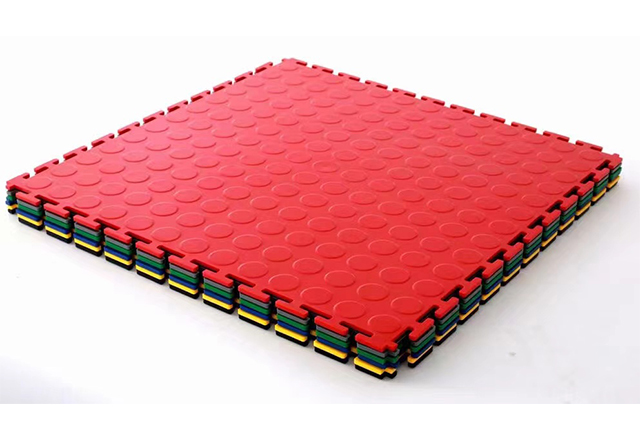
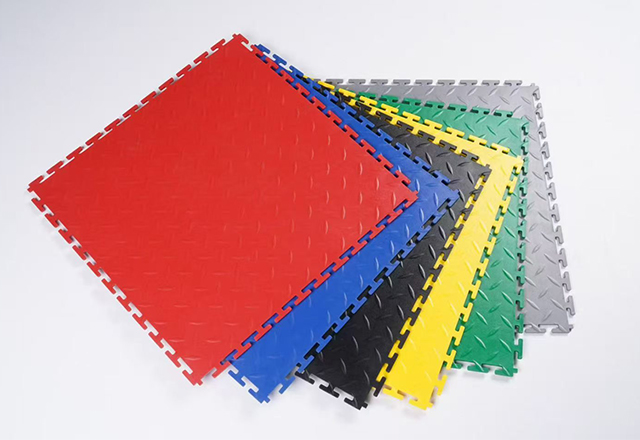
Choosing the right surface pattern is an important part of selecting industrial PVC flooring tiles. While coin pattern and diamond pattern PVC tiles are both popular options for warehouses, workshops, factories, garages, and commercial facilities, their surface designs offer different practical advantages.
The best choice depends on more than appearance. Buyers should consider foot traffic, material handling equipment, cleaning requirements, workplace safety, and the overall operating environment.
In this guide, we compare coin pattern vs diamond pattern PVC tiles to help you select the right industrial flooring solution for your facility.
1. What Are Coin Pattern PVC Tiles?
Coin pattern PVC tiles feature a raised circular or coin-shaped texture distributed across the tile surface. This design creates a recognizable industrial appearance and provides multiple raised contact points underfoot.
Coin pattern flooring is commonly considered for areas where employees walk frequently, equipment moves across the floor, and a durable, easy-to-maintain surface is required.
Key Features of Coin Pattern PVC Tiles
Distinctive surface texture: Repeated circular raised features create a consistent, recognizable pattern.
Industrial appearance: Suitable for warehouses, workshops, production areas, and utility spaces.
Practical maintenance: Routine cleaning can remove ordinary dust and loose debris, although cleaning methods should match the surface texture and contamination level.
Versatile applications: Can be considered for pedestrian areas, workstations, storage areas, and selected light- to medium-duty industrial environments, subject to product specifications.
Coin pattern PVC flooring is a practical option for buyers who prefer a uniform, functional surface design for everyday industrial operations.
2. What Are Diamond Pattern PVC Tiles?
Diamond pattern PVC tiles feature raised diamond-shaped ribs or intersecting diagonal lines across the surface. The pattern creates a more directional, textured appearance often associated with industrial platforms and workshop flooring.
Diamond pattern PVC flooring may be suitable for facilities that prefer a pronounced industrial surface design. However, the actual grip and wear performance depend on the tile formulation, surface geometry, and test results rather than the pattern name alone.
Key Features of Diamond Pattern PVC Tiles
Geometric surface design: Raised diamond features provide a structured industrial appearance.
Pronounced texture: The surface geometry may help provide traction under suitable conditions, but slip resistance must be verified through appropriate testing.
Industrial-style finish: Often considered for workshops, service areas, maintenance spaces, and selected production environments.
Application flexibility: Can be evaluated for pedestrian and equipment traffic when the product's load-bearing and wear characteristics are appropriate.
For industrial buyers, diamond pattern PVC tiles are worth considering when the surface design needs to complement the facility's functional requirements and visual standards.
3. Coin Pattern vs Diamond Pattern PVC Tiles: Key Differences
The two patterns may look different, but neither is automatically better for every industrial application.
Comparison Factor
Coin Pattern PVC Tiles
Diamond Pattern PVC Tiles
Surface appearance
Repeated circular raised features
Raised diamond-shaped ribs or intersecting lines
Visual style
Uniform and relatively simple
More directional and geometric
Common selection factors
General industrial use and everyday traffic
Industrial appearance and specific surface-texture preferences
Slip resistance
Depends on the complete product and test conditions
Depends on the complete product and test conditions
Cleaning
Depends on surface geometry and contamination
Depends on surface geometry and contamination
Abrasion resistance
Depends on PVC formulation and wear performance
Depends on PVC formulation and wear performance
Forklift suitability
Requires load and rolling-traffic evaluation
Requires load and rolling-traffic evaluation
Installation
Depends on tile design and connection system
Depends on tile design and connection system
Important: Surface pattern alone does not determine load capacity, abrasion resistance, chemical resistance, or slip resistance. These properties must be assessed using the actual product specifications and, where necessary, relevant test reports.
4. Which PVC Tile Pattern Is Better for Warehouses?
Warehouses often combine pedestrian traffic, pallet handling, storage operations, and material movement. The correct flooring choice should reflect how the facility operates rather than relying on appearance alone.
Coin Pattern for General Warehouse Areas
Coin pattern PVC tiles may be considered for general storage areas, packing stations, pedestrian aisles, and other spaces where a consistent industrial surface is preferred.
Before selecting a product, assess:
The type and weight of equipment used.
Whether pallet trucks or forklifts operate on the tiles.
The frequency of turning, braking, and acceleration.
The condition and flatness of the existing concrete floor.
The expected cleaning routine and contamination risks.
Diamond Pattern for Industrial Work Areas
Diamond pattern PVC tiles may suit workshops, maintenance zones, and production areas where a more pronounced geometric surface is preferred.
For warehouse applications involving heavy equipment, buyers should confirm the tile's thickness, dimensional stability, joint integrity, and performance under dynamic rolling loads. A visually aggressive surface pattern does not guarantee that the product can withstand forklift traffic.
For either pattern, request technical evidence before specifying the flooring for demanding applications.
5. Which Pattern Is Better for Workshops and Factories?
Workshops and factories may experience a combination of foot traffic, tools, carts, machinery, oil contamination, and localized impact.
When comparing coin and diamond pattern PVC tiles, consider the following factors.
Pedestrian traffic: Both patterns may be suitable for pedestrian areas, depending on their tested slip performance and the conditions in which they will be used.
Machinery and rolling loads: Check the manufacturer's specifications for the intended equipment, wheel loads, turning movements, and frequency of traffic.
Oil and chemical exposure: Verify compatibility with the actual substances used in the facility. PVC flooring should not be assumed to resist every oil, solvent, or industrial chemical.
Maintenance requirements: Consider how the texture affects the removal of dust, grease, and production residues. Cleaning performance should be assessed under the facility's real operating conditions.
Existing floor condition: Interlocking PVC tiles generally require a suitable, stable substrate. Significant cracks, unevenness, or loose concrete may need repair before installation.
The best surface pattern is the one that meets the operational requirements while remaining practical to maintain.
6. Coin Pattern vs Diamond Pattern: Slip Resistance and Workplace Safety
Slip resistance is a key consideration for industrial flooring, especially in areas exposed to water, oil, dust, or other contaminants.
However, a coin pattern is not automatically safer than a diamond pattern, and a diamond pattern is not automatically more slip-resistant because it looks more textured.
Actual slip performance depends on several variables:
Surface geometry and finish.
PVC material formulation.
Footwear and contact conditions.
The presence of water, oil, dust, or other contaminants.
The test method and conditions used to measure slip resistance.
For example, an EN 13893 result describes a particular friction test under its specified conditions. It should not be treated as proof of slip resistance in every oil-contaminated or wet industrial environment.
If slip resistance is a critical purchasing requirement, ask the supplier for the relevant test method, result, and test conditions. For oil-wet areas, request evidence that specifically addresses the intended operating environment.
7. Do Coin and Diamond Pattern PVC Tiles Have the Same Load Capacity?
Not necessarily, but the surface pattern alone is not enough to determine the difference.
Load performance is affected by the PVC compound, tile thickness, overall construction, locking design, substrate condition, wheel dimensions, and type of traffic.
A tile designed for pedestrian traffic may not be suitable for a loaded forklift, even if its surface looks heavy-duty.
When evaluating industrial PVC tiles, buyers should distinguish between:
Static load: A load applied while the equipment or object remains stationary.
Dynamic rolling load: A load applied while wheels move across the flooring.
Turning and braking loads: Additional stresses created when vehicles change direction or stop.
Point loads: Concentrated forces applied over a small contact area.
For forklift applications, request technical information that matches the actual operating conditions. A general weight rating without details about wheel configuration, movement, test conditions, and substrate may be insufficient for a reliable flooring specification.
At NAMA RUBBER, we recommend evaluating the complete flooring system rather than selecting a product based on its surface pattern alone.
8. Installation and Maintenance Considerations
Both coin pattern and diamond pattern PVC tiles may be available in different installation formats. The installation method depends on the specific product, including whether it uses interlocking edges, loose-lay construction, or another fixing system.
Before installation, check the following:
Subfloor preparation: Ensure the concrete is stable, clean, and sufficiently level for the selected tile system.
Tile compatibility: Confirm the dimensions, thickness, edge design, and connection system.
Traffic planning: Identify forklift routes, turning zones, loading areas, and pedestrian walkways.
Expansion and perimeter details: Follow the manufacturer's instructions for clearances, transitions, and perimeter finishing.
Cleaning procedures: Use cleaning agents and methods compatible with the PVC material.
Inspection and repair: Establish a routine for checking joints, damaged tiles, and areas exposed to concentrated traffic.
For heavy-duty applications, confirm whether the proposed interlocking system and installation method are suitable for repeated rolling and turning movements.
9. How to Choose the Right PVC Tile Pattern for Your Project
Use the following checklist when comparing coin pattern and diamond pattern PVC tiles.
Your Requirement
What to Check
Warehouse storage
Pedestrian traffic, pallet handling, and equipment movement
Manufacturing workshop
Machinery loads, impact exposure, and maintenance requirements
Forklift traffic
Dynamic rolling loads, turning, braking, wheel configuration, and joint performance
Wet or contaminated areas
Relevant slip-resistance test results and contamination conditions
Oil or chemical exposure
Product-specific chemical compatibility
Fast renovation
Installation method, substrate preparation, and downtime
Long-term durability
Abrasion, dimensional stability, locking strength, and maintenance
Consistent industrial appearance
Pattern, color availability, transitions, and replacement-tile compatibility
If you are unsure which pattern is appropriate, provide your supplier with the intended application, traffic type, approximate load, and existing floor condition. This makes it easier to compare suitable products based on measurable performance.
10. Why Consider NAMA RUBBER Industrial PVC Flooring?
NAMA RUBBER supplies flooring solutions for industrial, commercial, garage, and fitness applications.
For buyers evaluating industrial interlocking PVC flooring, the selection process should begin with the project's actual requirements, including traffic conditions, tile thickness, installation constraints, and relevant technical documentation.
When requesting a quotation, you can specify:
Preferred coin or diamond surface pattern.
Required tile thickness and dimensions.
Project area in square meters.
Forklift, pallet truck, or pedestrian traffic.
Expected wheel loads and operating conditions.
Existing concrete floor condition.
Required colors, accessories, and delivery destination.
These details help establish whether a particular flooring product is appropriate for the intended application.
Explore our Interlocking PVC Flooring Tiles to learn more about our industrial flooring options.
Conclusion: Coin Pattern or Diamond Pattern PVC Tiles?
Coin pattern and diamond pattern PVC tiles each offer a distinct industrial appearance, but the surface design should not be the only factor in your decision.
Coin patterns may appeal to buyers seeking a uniform, straightforward industrial finish, while diamond patterns may be preferred for their geometric, directional appearance. Neither pattern should be assumed to offer superior grip, wear resistance, or load capacity without supporting product data.
For warehouses, workshops, and factories, the best choice is the flooring system that matches the actual traffic conditions, environmental exposure, maintenance requirements, and installation needs.
Need help selecting industrial PVC flooring for your project? Contact NAMA RUBBER with your application details, required thickness, project quantity, and equipment information. Our team can help you evaluate the relevant product specifications and identify a suitable option.
Frequently Asked Questions
1. What is the main difference between coin pattern and diamond pattern PVC tiles?
Coin pattern PVC tiles have repeated circular raised features, while diamond pattern tiles have raised diamond-shaped ribs or intersecting diagonal lines. The main visible difference is the surface geometry. Their performance depends on the complete product design and material properties.
2. Are coin pattern PVC tiles better for warehouses?
Coin pattern tiles may be suitable for general warehouse areas, but suitability depends on traffic, equipment, loading conditions, and the specific product specifications. Forklift applications require additional evaluation of dynamic rolling loads and joint performance.
3. Are diamond pattern PVC tiles more slip-resistant?
Not necessarily. A more pronounced texture does not automatically mean better slip resistance. Compare relevant test results obtained using appropriate methods and conditions for the intended application.
4. Can industrial PVC tiles support forklifts?
Some industrial PVC tile systems may be suitable for selected forklift applications, but not all products are designed for heavy rolling traffic. Verify wheel loads, vehicle movements, substrate conditions, tile construction, and test evidence before installation.
5. Are coin and diamond pattern PVC tiles easy to clean?
Both can be maintained using suitable cleaning methods. The ease of cleaning depends on the surface geometry, the type of contamination, and the cleaning equipment used. Facilities exposed to grease or industrial residues should assess maintenance requirements before choosing a product.
6. Which PVC tile pattern is better for a factory workshop?
Neither pattern is universally better. Compare the intended traffic, chemical exposure, slip requirements, abrasion performance, and maintenance needs. The correct choice should be based on product data and actual site conditions.
7. How do I request a quotation for industrial PVC flooring?
Provide the application, required tile thickness, project area, surface pattern, expected traffic, destination country, and any specific technical requirements. For forklift applications, include the vehicle and wheel information so the product can be evaluated more accurately.
Post time: Oct-21-2026