
Introduction
Automotive workshops are among the most demanding environments for industrial flooring.
A typical workshop floor may need to handle:
Cars, vans and commercial vehicles
Vehicle lifts and jacks
Tool carts and equipment
Engine and transmission components
Oil, grease and coolant
Brake fluid and cleaning chemicals
Heavy rolling loads
Metal tools and dropped parts
Water and mud
Frequent cleaning
Continuous employee and vehicle traffic
A workshop floor therefore needs to be more than attractive.
It needs to be durable, slip-resistant, easy to clean, resistant to common workshop contaminants and practical to repair.
For workshop owners, facility managers and flooring contractors, the right question is not simply:
“What is the cheapest garage floor?”
A better question is:
“Which flooring system provides the right combination of load performance, chemical resistance, safety, maintenance and downtime for this workshop?”
This guide explains the main options for industrial flooring for automotive workshops, including concrete, epoxy, polyurethane systems, interlocking PVC tiles and rubber flooring.
1. Why Automotive Workshop Flooring Is Different
An automotive workshop combines several types of mechanical and environmental stress.
Unlike a normal warehouse, the floor may be exposed to both vehicle traffic and workshop chemicals.
At the same time, different zones of the workshop may have completely different requirements.
For example:
A vehicle repair bay needs heavy-duty performance.
A detailing area needs water resistance and easy cleaning.
A customer reception area has mostly pedestrian traffic.
A vehicle lift area experiences concentrated loads.
A parts storage area may use pallet trucks or forklifts.
This means a workshop does not necessarily need one flooring specification throughout the entire facility.
2. Key Requirements for Automotive Workshop Flooring
When selecting flooring for an automotive repair shop, consider at least eight factors.
2.1 Load resistance
The floor must support:
Vehicles
Vehicle lifts
Jacks
Tool cabinets
Wheel equipment
Engine stands
Transmission jacks
However, the total vehicle weight is not the only consideration.
Concentrated loads from lift posts, jack stands or equipment feet can create much higher local pressure.
2.2 Oil and chemical resistance
Automotive workshops commonly deal with:
Engine oil
Gear oil
Transmission fluid
Coolant
Brake fluid
Grease
Degreasers
Cleaning chemicals
Fuel-related contamination
A suitable floor should be evaluated against the chemicals actually used in the workshop.
Do not assume that every PVC, rubber or resin floor has the same chemical resistance.
Always check product-specific technical data.
2.3 Slip resistance
Oil and water can significantly increase slip risk.
A smooth-looking floor is not necessarily the safest floor in a workshop environment.
Surface texture, contamination, cleaning procedures and drainage all need to be considered.
For areas where oil or water is regularly present, request the relevant slip-resistance test data from the flooring supplier.
2.4 Abrasion resistance
Vehicle wheels, tool carts and equipment can create thousands of rolling movements over the lifetime of a floor.
High-traffic zones may include:
Workshop entrances
Repair bays
Vehicle inspection areas
Tire service areas
Parts handling areas
Driveways between workstations
Abrasion resistance becomes particularly important in these locations.
2.5 Impact resistance
Automotive workshops are working environments.
Tools and components can be dropped.
Metal parts may fall from workbenches.
Heavy equipment may be moved across the floor.
A flooring system should therefore be evaluated for impact resistance as well as static load.
2.6 Ease of cleaning
A good automotive workshop floor should allow employees to remove:
Oil
Grease
Dirt
Rubber particles
Metal dust
Cleaning chemicals
A surface that is difficult to clean can increase both labor costs and housekeeping time.
2.7 Repairability
Damage is inevitable in busy workshops.
The important question is:
How difficult is it to repair?
With a modular flooring system, localized damage may be addressed by replacing individual tiles.
With a seamless resin floor, repairs typically require preparation and patching of the affected area.
The best approach depends on the workshop's operating requirements.
2.8 Installation downtime
A workshop may not be able to stop operations for several days.
Every day of closure can mean:
Lost vehicle appointments
Lost labor utilization
Delayed repairs
Reduced revenue
Therefore, installation time should be included in the flooring decision.
3. Best Flooring Options for Automotive Workshops
The main flooring options include:
Concrete
Epoxy
Polyurethane / resin systems
Interlocking PVC tiles
Rubber flooring
There is no single best material for every workshop.
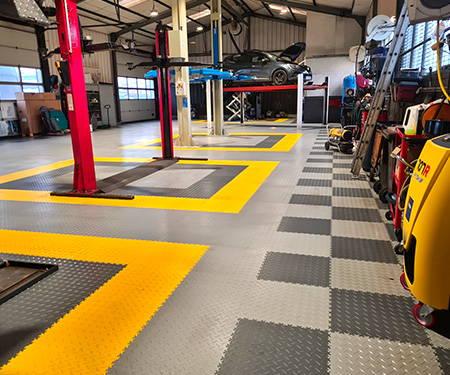
4. Concrete Flooring
Concrete is the traditional foundation for many automotive workshops.
A properly designed concrete slab can support substantial structural loads.
Advantages
High structural load capacity
Durable substrate
Widely available
Suitable for heavy vehicles
Long service potential
Limitations
Unprotected concrete can suffer from:
Dusting
Oil staining
Surface abrasion
Cracking
Difficult cleaning
Poor appearance
For many workshops, concrete is better considered as the structural base rather than the ideal finished working surface.
5. Epoxy Flooring for Auto Repair Shops
Epoxy is one of the most widely recognized flooring options for automotive workshops.
It creates a hard, seamless surface when properly installed.
Advantages
Seamless appearance
Easy cleaning
Good abrasion resistance
Good chemical resistance for suitable formulations
Professional appearance
Available in different systems and finishes
Limitations
Epoxy flooring is highly dependent on installation quality.
Important factors include:
Concrete preparation
Moisture condition
Surface contamination
Primer selection
Coating thickness
Application quality
Curing conditions
If the concrete moves or cracks, the finished system can be affected.
Epoxy may also require installation and curing time, which can increase workshop downtime.
6. Interlocking PVC Flooring for Automotive Workshops
Heavy-duty interlocking PVC flooring can be an interesting solution for automotive workshops, particularly renovation projects where installation speed and repairability are important.
PVC tiles are connected through mechanical interlocking edges.
Some systems are designed for loose-lay installation without full-surface adhesive.
Potential advantages
Fast installation
The modular format can reduce installation time compared with some wet-applied flooring systems.
Reduced downtime
Work areas can potentially be renovated with less disruption.
Localized replacement
A damaged tile can potentially be removed and replaced individually.
Phased installation
Workshops can renovate different areas in stages.
No curing period for suitable loose-lay systems
This can be useful where the workshop needs to return to operation quickly.
However, product selection is critical.
Not every PVC tile is designed for:
Vehicle traffic
Vehicle lifts
Heavy jacks
Oil exposure
Point loads
Workshop chemicals
Always evaluate the actual technical specification.
7. Is PVC Flooring Suitable for Vehicle Lifts?
This is an important technical question.
A vehicle lift can create highly concentrated point loads.
For example, the lift posts or support points may transfer significant loads to relatively small areas.
Therefore, simply asking:
"Can the PVC floor support a car?"
is not enough.
The correct evaluation should consider:
Vehicle weight
Lift type
Number of support points
Contact area
Maximum wheel load
Lift post load
Dynamic loading
Flooring compression resistance
Residual indentation
In some applications, load-distribution plates or reinforced areas may be necessary.
The flooring manufacturer should review the specific lift configuration before confirming suitability.
8. PVC Flooring vs Epoxy for Automotive Workshops
Feature Interlocking PVC Epoxy
Installation speed Fast Moderate
Seamless surface No Yes
Local repair Excellent Moderate
Individual replacement Possible No
Full-surface adhesive Not always required Typically part of system
Curing time None for suitable loose-lay systems Required
Chemical resistance Product-specific Generally good for suitable systems
Oil resistance Product-specific Good for suitable systems
Vehicle traffic Product-specific Good for suitable systems
Point loads Must be verified Must be verified
Renovation Very practical More disruptive
Maintenance Modular Coating repair
Neither system is automatically better.
The correct choice depends on the workshop's priorities.
9. Rubber Flooring for Automotive Workshops
Rubber flooring can be useful in selected workshop areas.
It can provide:
Good impact absorption
Comfortable standing surface
Noise reduction
Slip resistance depending on surface design
Good resilience
Rubber flooring can be particularly attractive in:
Technician workstations
Tool areas
Assembly areas
Maintenance zones
However, rubber formulations vary considerably.
Before selecting rubber flooring for an automotive workshop, check its resistance to:
Oils
Grease
Fuel
Solvents
Cleaning chemicals
For areas with frequent oil exposure, a product specifically designed for that environment should be selected.
10. Heavy-Duty PVC Flooring Thickness
Industrial PVC tiles may be available in different thicknesses, such as:
5 mm
7 mm
8 mm
10 mm
Other application-specific specifications
But:
Thicker does not automatically mean better.
A 10 mm tile is not automatically more suitable than an 8 mm tile for every workshop.
Compare the complete specification:
Thickness
Density
Hardness
Wear resistance
Compression performance
Residual indentation
Point-load resistance
Interlocking strength
Chemical resistance
Wheel compatibility
The application should determine the specification.
11. Workshop Floor Zones Should Be Evaluated Separately
One of the most effective ways to design automotive workshop flooring is to divide the facility into zones.
Zone 1 — Vehicle Repair Bays
Requirements:
High load resistance
Oil resistance
Slip resistance
Abrasion resistance
Easy cleaning
Zone 2 — Vehicle Lift Areas
Requirements:
High point-load resistance
Compression resistance
Stable substrate
Suitable load distribution
This area deserves particular attention when using modular flooring.
Zone 3 — Tire Service Areas
These areas may experience:
Heavy rolling equipment
Rubber particles
Tools
Vehicle wheels
Frequent traffic
Durability and easy cleaning are important.
Zone 4 — Detailing & Washing Areas
Key concerns include:
Water
Cleaning chemicals
Slip resistance
Drainage
Frequent cleaning
A flooring system designed for dry workshop areas may not automatically be the best choice here.
Zone 5 — Parts Storage
Parts storage areas may have:
Shelving
Pallet trucks
Small forklifts
Heavy components
Load distribution and rolling traffic should be considered.
Zone 6 — Customer & Reception Areas
These areas have different requirements.
Appearance, comfort and cleanability may be more important than extreme mechanical loading.
12. Oil Resistance: An Important Workshop Requirement
Oil exposure is one of the biggest differences between automotive workshops and ordinary warehouses.
A workshop floor may encounter oil repeatedly over many years.
When evaluating flooring, ask:
What oil?
Engine oil?
Transmission fluid?
Hydraulic oil?
How frequent?
Occasional spill?
Daily exposure?
How long does it remain on the surface?
Minutes?
Hours?
Days?
How is it cleaned?
Water?
Detergent?
Degreaser?
The correct flooring should be selected based on actual chemical exposure, not a generic claim such as "oil resistant."
13. Slip Resistance in Automotive Workshops
Slip resistance becomes particularly important when the floor is contaminated.
Potential contaminants include:
Oil
Coolant
Water
Mud
Grease
Cleaning products
A flooring system should therefore be evaluated under realistic operating conditions.
But there is also a trade-off.
A highly textured surface may provide additional grip but can sometimes be more difficult to clean.
Therefore:
The best surface is not necessarily the roughest surface.
The correct balance depends on the application.
14. How to Choose the Right Automotive Workshop Flooring
Use the following process.
Step 1 — Identify vehicle types
Are you servicing:
Passenger cars?
SUVs?
Vans?
Trucks?
Commercial vehicles?
Electric vehicles?
Different vehicle weights create different requirements.
Step 2 — Identify workshop equipment
List:
Vehicle lifts
Jacks
Tire changers
Wheel balancers
Tool carts
Compressors
Engine stands
Step 3 — Identify chemical exposure
List the actual fluids and cleaning products used.
Step 4 — Measure traffic
How many vehicles enter the workshop every day?
How many times do vehicles turn or reverse?
How much pedestrian traffic is present?
Step 5 — Inspect the concrete
Check:
Cracks
Flatness
Moisture
Surface contamination
Drainage
Existing joints
Step 6 — Define downtime
Ask:
How many days can the workshop realistically be closed?
If downtime is extremely limited, modular flooring deserves serious consideration.
15. Automotive Workshop Flooring Buying Checklist
Before requesting quotations, prepare the following information:
Item Requirement
Workshop type Auto repair / Truck repair / Tire shop
Floor area ___ m²
Vehicle type ___
Maximum vehicle weight ___ kg
Vehicle lift Yes / No
Lift type ___
Maximum lift load ___ kg
Forklift / pallet truck Yes / No
Wheel type ___
Traffic frequency ___ vehicles/day
Oil exposure Low / Medium / High
Chemical exposure ___
Washing area Yes / No
Drainage ___
Existing floor Concrete / Other
Floor condition ___
Required downtime ___
Preferred installation Loose-lay / Adhesive / Coating
Project location ___
This information makes supplier quotations much more accurate.
16. Common Mistakes When Choosing Garage Workshop Flooring
Choosing flooring based only on appearance
A floor can look excellent but still be unsuitable for heavy vehicle traffic.
Assuming every industrial PVC tile is suitable for cars
PVC flooring products have different load and chemical resistance specifications.
Ignoring vehicle lift loads
Lift posts can create concentrated point loads that are very different from normal vehicle wheel loads.
Choosing thickness without checking performance
8 mm versus 10 mm is not enough information.
Ignoring oil and chemical exposure
Automotive workshops have unique contamination risks.
Forgetting drainage
Washing and cleaning areas require appropriate water management.
Focusing only on material price
Installation time, maintenance and downtime can have a major impact on the real project cost.
17. Total Cost of Ownership for Workshop Flooring
When comparing flooring systems, consider more than the initial quotation.
A useful framework is:
TCO = Material + Installation + Maintenance + Repairs + Downtime + Replacement
For example, an inexpensive floor that requires frequent repair may ultimately cost more than a higher-quality system.
Similarly, a flooring system with a higher material price may make economic sense if it:
Installs faster
Requires less downtime
Is easier to repair
Reduces maintenance
Provides longer service life
For commercial automotive workshops, downtime has a real business cost.
18. FAQ: Automotive Workshop Flooring
What is the best flooring for an automotive workshop?
The best option depends on the workshop's vehicle weight, equipment, chemical exposure, traffic and downtime requirements.
Epoxy, polyurethane, concrete and heavy-duty PVC flooring can all be suitable for different applications.
Is PVC flooring good for auto repair shops?
Heavy-duty industrial PVC tiles can be suitable for certain automotive workshop applications, especially renovation projects where fast installation and localized repair are important.
However, vehicle lift loads, oil exposure and point loads must be checked against the specific product specification.
Can interlocking PVC tiles handle cars?
Some heavy-duty interlocking PVC tiles can handle vehicle traffic, but suitability depends on the product specification and vehicle loading.
Always check the manufacturer's load and wheel recommendations.
Can PVC tiles be used under a car lift?
This requires specific evaluation.
Vehicle lift posts can create concentrated point loads. The flooring manufacturer should review the lift type, load and contact area before confirming suitability.
Is epoxy better than PVC for a garage workshop?
Not necessarily.
Epoxy provides a seamless, hard surface and can be excellent for many workshops.
Interlocking PVC can provide faster installation, easier localized replacement and potentially less downtime.
What is the best flooring for an oily workshop?
Choose a system with documented chemical resistance appropriate for the actual oils, fluids and cleaning chemicals used.
Slip resistance and cleaning requirements should also be considered.
19. Final Recommendation
The best industrial flooring for an automotive workshop should be selected according to the actual working environment.
Before choosing a product, evaluate:
Vehicle load
What vehicles will enter the workshop?
Equipment
Will the floor support lifts, jacks, tire equipment or heavy machinery?
Point loads
Where are the concentrated loads?
Chemicals
What oils, fluids and cleaning chemicals will contact the floor?
Traffic
How frequently will vehicles and equipment move across the floor?
Moisture
Will the area be washed or exposed to water?
Maintenance
How easy is localized repair?
⏱️ Downtime
How long can the workshop stop operating?
The goal isn't to find the thickest or cheapest floor.
The goal is to find a flooring system that provides the right balance of:
Load performance + chemical resistance + slip resistance + durability + installation speed + maintenance + total cost of ownership.
Need Industrial Flooring for Your Automotive Workshop?
Planning a new auto repair shop, truck workshop, tire center, vehicle service facility or garage renovation?
Send us:
Floor area
Vehicle types
Maximum vehicle weight
Vehicle lift type & capacity
Oil / chemical exposure
Forklift or equipment traffic
Existing concrete condition
Washing / drainage requirements
Available installation time
Project location
With these details, a flooring supplier can recommend a specification based on your actual workshop conditions rather than simply quoting a standard floor.
Post time: Sep-09-2026