
Introduction
Cold storage facilities create some of the most demanding conditions for industrial flooring.
Unlike a standard warehouse, a refrigerated warehouse or freezer room may experience:
Low temperatures
Frequent temperature changes
Condensation and moisture
Water and ice
Heavy pallet loads
Forklift and pallet truck traffic
Repeated braking and turning
Food, chemical or cleaning-agent exposure
Strict hygiene requirements
Frequent cleaning and sanitation
Choosing the right industrial flooring for cold storage facilities is therefore more than selecting a material based on price per square meter.
The flooring system needs to remain stable under the expected temperature range while handling mechanical traffic, moisture and daily operational demands.
For cold storage operators, food distributors, logistics companies and warehouse developers, the key question is:
Can the flooring continue to perform reliably under the actual temperature, load and traffic conditions of the facility?
This guide explains the major factors to consider when selecting flooring for refrigerated warehouses, cold rooms and freezer facilities, with a particular focus on heavy-duty industrial PVC flooring.
1. Why Cold Storage Flooring Is Different
Cold storage flooring operates under conditions that can be significantly more demanding than normal warehouse environments.
A typical ambient warehouse may operate around normal indoor temperatures. A chilled or frozen facility, however, can operate at substantially lower temperatures depending on the application.
This creates several challenges for flooring materials.
1.1 Low-temperature performance
Materials can behave differently when temperatures decrease.
Some materials become less flexible or more brittle at low temperatures. This can affect:
Impact resistance
Dimensional stability
Joint performance
Surface durability
Resistance to cracking
Therefore, a flooring material that performs well at room temperature should not automatically be assumed suitable for freezer applications.
Always verify the manufacturer's low-temperature performance data for the actual product.
1.2 Thermal cycling
Cold storage facilities don't necessarily remain at one constant temperature.
Doors open and close.
Goods enter and leave.
Cleaning takes place.
Equipment moves between temperature zones.
These activities can create repeated temperature changes.
Over time, thermal cycling can place stress on the flooring system, particularly where different materials meet or where the flooring is installed over an unsuitable substrate.
1.3 Moisture and condensation
Moisture is another major concern.
Cold surfaces can create condensation, while cleaning operations may introduce additional water.
Potential problems include:
Slippery surfaces
Water accumulation
Ice formation
Substrate deterioration
Bacterial growth in poorly designed areas
Adhesive-related problems
Damage around joints and edges
For this reason, cold storage flooring should be evaluated as part of the complete floor system, including drainage, substrate, joints and installation method.
2. What Makes a Good Cold Storage Floor?
A suitable flooring solution for a refrigerated or frozen warehouse should be evaluated against several performance criteria.
Key requirements include:
Low-temperature suitability
The flooring should have documented performance appropriate for the intended operating temperature.
Load resistance
The floor needs to withstand:
Pallet loads
Rack loads
Forklift traffic
Pallet trucks
Electric stackers
Warehouse equipment
Abrasion resistance
Repeated vehicle traffic can cause significant wear, particularly in:
Loading areas
Turning zones
Aisles
Doorways
Staging areas
Slip resistance
Water, condensation and ice can increase slip risks.
Surface design and the overall drainage strategy therefore become important.
Dimensional stability
The flooring should remain stable under temperature changes and operational conditions.
Moisture resistance
The floor should be suitable for the expected cleaning and moisture environment.
Easy maintenance
Cold storage facilities generally benefit from flooring that can be cleaned efficiently without creating excessive downtime.
Repairability
If a localized area becomes damaged, the ability to repair or replace only the affected section can reduce maintenance disruption.
3. Industrial PVC Flooring for Cold Storage
Industrial PVC flooring can be an attractive option for certain cold storage applications, particularly where modular interlocking systems are appropriate.
Interlocking PVC tiles are manufactured with mechanical connections that allow individual tiles to connect without necessarily relying on a full-surface adhesive installation.
This can provide several practical advantages for renovation and maintenance projects.
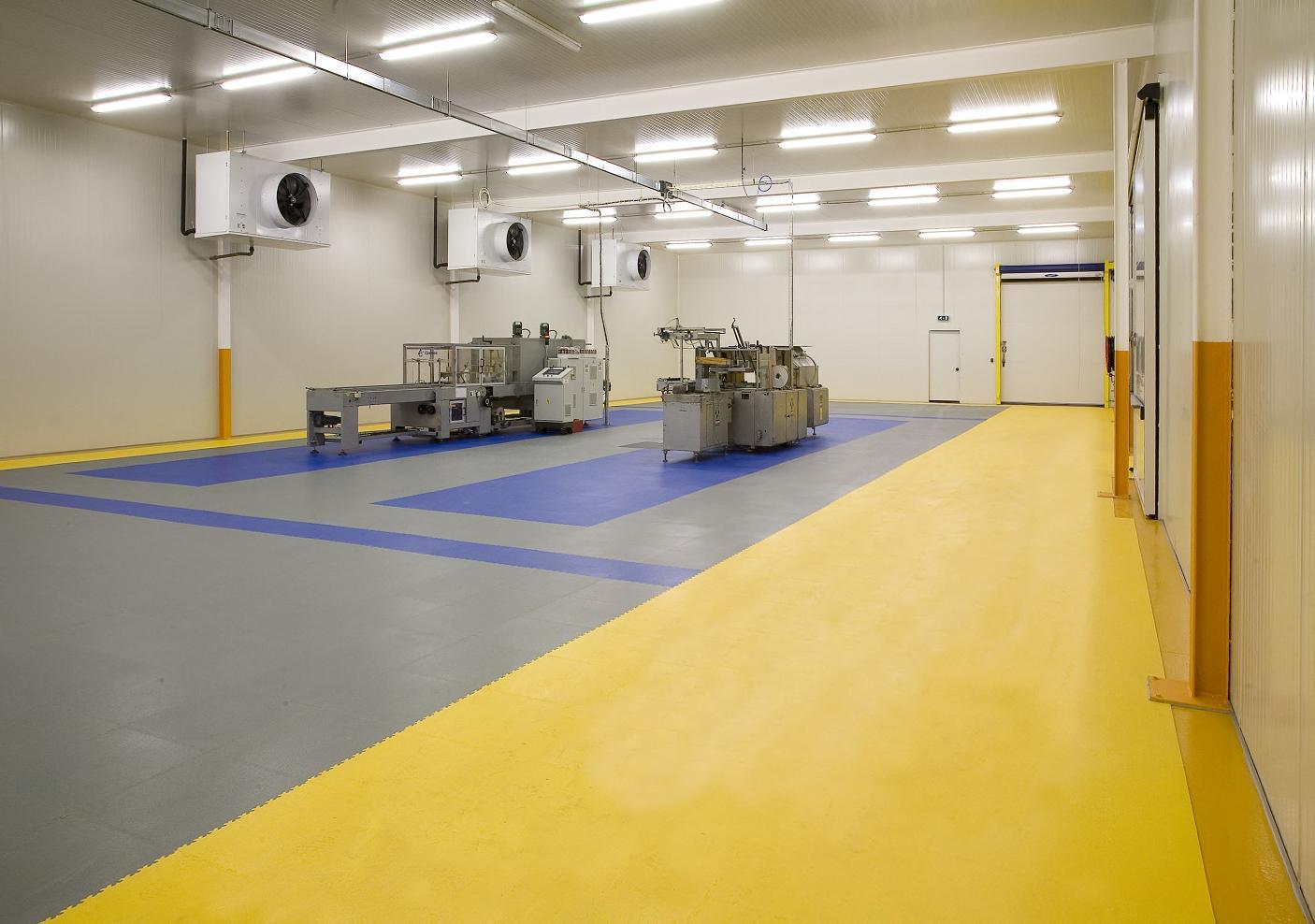
Potential advantages include:
Fast installation
Interlocking tiles can often be installed faster than traditional wet-applied flooring systems, depending on the substrate and project conditions.
Minimal installation disruption
For operating warehouses, reducing downtime can be commercially important.
Localized replacement
Damaged tiles can potentially be removed and replaced individually rather than repairing an entire floor area.
Modular construction
Different floor zones can potentially be managed or renovated in stages.
No full-surface adhesive in suitable applications
Some interlocking systems are designed for loose-lay installation.
However, this does not mean every interlocking PVC tile is automatically suitable for freezer rooms.
4. Is PVC Flooring Suitable for Freezer Rooms?
This is one of the most important questions buyers should ask.
The answer depends on the specific PVC product.
Not all PVC flooring products have the same formulation, flexibility, dimensional stability or temperature performance.
Before specifying PVC flooring for a freezer or cold storage application, request technical information covering:
Minimum operating temperature
Recommended temperature range
Dimensional stability
Hardness
Wear resistance
Impact resistance
Load capacity
Slip resistance
Chemical resistance
Installation requirements
For particularly low-temperature environments, product-specific testing is essential.
Do not select a flooring system simply because it is marketed as "industrial PVC flooring."
5. Cold Storage Flooring vs Standard Warehouse Flooring
A standard warehouse and a freezer warehouse can have very different flooring requirements.
Requirement Standard Warehouse Cold Storage / Freezer
Temperature Normal ambient Low temperature
Thermal cycling Moderate Potentially significant
Moisture Moderate High
Condensation Usually limited Common concern
Ice Usually absent Possible
Forklift traffic Common Common
Pallet loads High High
Slip risk Moderate Potentially higher
Cleaning Regular Often intensive
Low-temperature testing Less critical Very important
This is why a flooring system that works perfectly well in a normal warehouse may not be the right choice for a freezer environment.
6. Forklift Traffic in Cold Storage Facilities
Forklifts are one of the biggest mechanical challenges for warehouse flooring.
The problem is not simply the total forklift weight.
You also need to consider:
Wheel load
The load transferred through individual wheels can be much higher than the average distributed floor load.
Dynamic loading
A moving forklift creates different forces from a stationary load.
Acceleration, braking and turning can increase stress on the flooring.
Wheel material
Forklift wheels may be made from different materials, including polyurethane and other high-hardness compounds.
The wheel type can significantly influence flooring wear.
Turning radius
Repeated turning in narrow aisles can create concentrated wear.
Traffic frequency
A floor carrying 10 forklift movements per day has a very different duty cycle from one carrying hundreds of movements.
A useful specification checklist
Before choosing industrial flooring, collect:
Forklift type:
Counterbalance / reach truck / pallet truck / stacker
Maximum vehicle load:
kg
Maximum pallet load:
kg
Wheel type:
PU / nylon / rubber / other
Traffic frequency:
Movements per day
Turning areas:
Yes / No
Operating temperature:
°C
This information allows the flooring supplier to make a more meaningful recommendation.
7. Moisture and Drainage Are Critical
Cold storage flooring should never be considered independently from drainage.
A good floor design should consider where water goes after:
Cleaning
Defrosting
Condensation
Equipment washing
Door opening
Ice melting
Poor drainage can create standing water.
Standing water can increase:
Slip risk
Hygiene problems
Material deterioration
Cleaning time
Maintenance costs
For food-related cold storage facilities, drainage design can be particularly important because sanitation requirements may be demanding.
8. Cold Room Flooring and Substrate Condition
The existing concrete floor is often overlooked during flooring selection.
Before installing a new industrial floor, inspect the substrate for:
Cracks
Unevenness
Moisture
Surface contamination
Damaged concrete
Expansion joints
Drainage slopes
Why does this matter?
Interlocking PVC tiles can provide a fast modular flooring solution, but they do not magically eliminate problems in a severely damaged or unsuitable substrate.
If the concrete is badly uneven or structurally damaged, corrective work may be necessary before installing the final flooring.
9. Interlocking PVC vs Epoxy for Cold Storage
Both systems can have applications in industrial environments, but their installation and maintenance characteristics are different.
Feature Interlocking PVC Tiles Epoxy Flooring
Installation Fast modular installation Multi-step application
Downtime Potentially lower Often higher
Local repair Easy tile replacement More involved repair
Wet installation No curing process for loose-lay systems Requires curing
Substrate preparation Still important Usually critical
Temperature considerations Product-specific Product/application-specific
Renovation Suitable for phased work More disruptive
Replacement Individual tiles possible Usually repaired in place
Forklift traffic Depends on specification Depends on system
Freezer suitability Must verify product data Must verify system data
The best option depends on the temperature, substrate, traffic, hygiene requirements and installation conditions.
10. What About Concrete Flooring?
Concrete is commonly used as the structural base in cold storage facilities.
However, exposed concrete may not always provide the ideal final working surface.
Potential problems include:
Dusting
Cracking
Surface wear
Difficult cleaning
Moisture-related deterioration
Poor appearance
Difficult localized repair
A flooring system can be used to improve the operational surface, but the underlying concrete still needs to be evaluated.
11. Flooring for Different Cold Storage Areas
Not every area of a cold storage facility has the same requirements.
Freezer Rooms
Priority considerations:
Low-temperature performance
Moisture
Ice
Slip resistance
Heavy loads
Forklift traffic
Chilled Storage Areas
Temperature conditions may be less severe than deep-freeze environments, but moisture and cleaning can still be important.
Loading & Unloading Areas
These areas often experience:
High traffic
Forklift turning
Pallet movement
Doorway temperature changes
Water and dirt
Durability and wear resistance are particularly important.
Cold Storage Aisles
Narrow aisles can concentrate forklift traffic.
Repeated turning and braking should be considered during product selection.
Packing & Processing Areas
Hygiene, cleanability and chemical resistance may become more important than maximum forklift load.
12. How Thick Should Cold Storage PVC Flooring Be?
There is no universal thickness that works for every cold storage application.
Common industrial PVC tile thicknesses may include 7 mm, 8 mm, 10 mm and other specifications, depending on the manufacturer.
However:
Thickness alone does not determine performance.
A thicker tile with an unsuitable formulation may perform worse than a thinner product specifically engineered for the application.
When comparing products, evaluate the complete specification:
Thickness
Density
Hardness
Wear resistance
Load performance
Interlocking strength
Temperature range
Dimensional stability
Wheel compatibility
Manufacturer test data
13. How to Choose Industrial Flooring for a Cold Storage Project
A practical purchasing process can be divided into six steps.
Step 1 — Define the temperature
What is the minimum operating temperature?
For example:
Chilled storage
Frozen storage
Deep-freeze environment
Do not provide only the average temperature.
The minimum expected temperature is particularly important.
Step 2 — Define the traffic
Identify:
Forklift type
Pallet truck type
Vehicle weight
Maximum pallet load
Wheel type
Traffic frequency
Step 3 — Inspect the existing floor
Check:
Flatness
Cracks
Moisture
Surface condition
Drainage
Joints
Step 4 — Define hygiene requirements
For food and pharmaceutical applications, determine:
Cleaning method
Cleaning frequency
Chemical exposure
Drainage requirements
Hygiene standards
Step 5 — Compare installation methods
Consider:
Interlocking PVC
vs.
Epoxy
vs.
Other industrial flooring systems
Compare not only material price but also:
Installation cost
Downtime
Maintenance
Repair
Replacement
Expected service life
Step 6 — Request application-specific documentation
Ask the supplier for technical information relevant to your operating environment.
Avoid accepting generic statements such as:
"Heavy duty."
Ask for measurable specifications instead.
14. Cold Storage Flooring Cost: Look Beyond Price per m²
The cheapest flooring is not necessarily the lowest-cost flooring solution.
A better calculation is:
Total Cost of Ownership
TCO = Initial flooring cost + installation + maintenance + repairs + downtime + replacement
For a busy cold storage facility, downtime can be particularly expensive.
For example, if a flooring system requires several days of preparation and curing, the indirect cost may be much greater than the difference in material price.
This is one reason modular flooring systems can be attractive for renovation projects where operational continuity is important.
15. Common Mistakes When Buying Cold Storage Flooring
Mistake 1: Choosing based only on price
A low initial price does not guarantee low long-term cost.
Mistake 2: Ignoring minimum temperature
A product suitable for normal warehouses may not be suitable for freezer environments.
Mistake 3: Looking only at thickness
Thickness is only one part of flooring performance.
Mistake 4: Ignoring forklift wheel type
Wheel material and load concentration can strongly influence wear.
Mistake 5: Forgetting drainage
Water and ice can become operational problems even when the flooring material itself is durable.
Mistake 6: Installing over an unsuitable substrate
A modular floor cannot compensate for major structural or substrate problems.
Mistake 7: Asking only for a product brochure
For an engineering project, technical data is more useful than marketing descriptions.
16. Cold Storage Flooring Specification Checklist
Before requesting quotations, prepare the following information:
Specification Project Requirement
Facility type Chilled / Frozen / Freezer
Floor area ___ m²
Minimum temperature ___ °C
Normal temperature ___ °C
Flooring type PVC / Epoxy / Other
Thickness ___ mm
Forklift type ___
Maximum forklift load ___ kg
Wheel type ___
Traffic frequency ___ movements/day
Pallet load ___ kg
Existing substrate Concrete / Other
Moisture condition ___
Drainage Yes / No
Cleaning method ___
Slip resistance requirement ___
Installation method Loose-lay / Adhesive / Other
Project location ___
Providing this information can significantly improve the accuracy of supplier recommendations and quotations.
17. Frequently Asked Questions
Can PVC flooring be used in cold storage?
Potentially, yes, but suitability depends on the specific PVC formulation, temperature range, loading conditions, installation method and manufacturer's technical data.
For freezer applications, always verify the product's low-temperature performance.
Is interlocking PVC flooring suitable for forklifts?
Heavy-duty interlocking PVC tiles can be designed for industrial vehicle traffic, but suitability depends on the tile specification, wheel type, load and traffic conditions.
A supplier should evaluate the actual forklift application rather than simply stating that the product is "forklift suitable."
Is thicker PVC flooring better for cold storage?
Not necessarily.
Thickness can improve certain performance characteristics, but formulation, density, hardness, wear resistance, interlocking strength and temperature performance also matter.
What is the best flooring for a freezer warehouse?
There is no single answer for every freezer warehouse.
The best flooring should be selected based on:
temperature + traffic + wheel load + moisture + hygiene + substrate + installation requirements.
Can interlocking PVC tiles be installed without adhesive?
Some interlocking PVC systems are designed for loose-lay installation without full-surface adhesive.
However, the manufacturer's installation instructions and project conditions should always be followed.
Can damaged PVC floor tiles be replaced?
One advantage of modular interlocking flooring is that individual damaged tiles can potentially be removed and replaced, reducing the need to renovate an entire floor.
18. Final Buying Advice
When purchasing industrial flooring for cold storage facilities, don't start with:
"How much is the flooring per square meter?"
Start with:
"What conditions will the floor need to survive?"
The most important factors are:
Temperature → Load → Wheel → Traffic → Moisture → Substrate → Installation → Maintenance
For a refrigerated warehouse or freezer project, the right flooring specification should be based on actual operating conditions rather than a generic "heavy-duty" label.
For interlocking PVC flooring in particular, confirm the product's low-temperature suitability, load performance, wear resistance, dimensional stability and installation requirements before placing an order.
Need a Cold Storage Flooring Recommendation?
Planning a cold storage warehouse, freezer room, refrigerated distribution center or food logistics facility?
Send us:
Floor area
Minimum operating temperature
Forklift / pallet truck type
Maximum load
Wheel type
Traffic frequency
Existing floor condition
Project location
With these details, a flooring supplier can evaluate the application and recommend a more suitable specification instead of simply quoting a standard industrial floor.
Post time: Sep-04-2026