
Industrial Flooring for E-commerce Warehouses
E-commerce warehouses operate under demanding conditions. Thousands of products may move through receiving, storage, picking, packing, sorting and dispatch areas every day.
Unlike a traditional storage warehouse, an e-commerce fulfillment center often combines high order volumes, frequent material handling, multiple traffic routes and rapidly changing operational requirements.
The floor is not simply a surface for people and equipment to move across. It is part of the infrastructure supporting the entire fulfillment process.
Choosing the right industrial flooring for e-commerce warehouses requires careful consideration of traffic intensity, equipment loads, surface condition, safety, maintenance and operational downtime.
For some facilities, a well-designed concrete floor or resin coating may be appropriate. For certain renovation projects, modular interlocking PVC floor tiles may also be worth evaluating, particularly when installation flexibility and localized maintenance are priorities.
This guide explains how to assess the available options and select a flooring system based on your warehouse's actual operating conditions.
Why Is Flooring Important in E-commerce Warehouses?
E-commerce fulfillment centers depend on continuous movement between different operational zones.
A typical facility may include:
- Goods receiving and unloading
- Inventory storage and racking
- Order picking
- Packing stations
- Conveyor and sorting systems
- Pallet staging
- Loading and dispatch
- Returns processing
- Maintenance areas
Each zone places different demands on the floor.
For example, a pedestrian picking area may require different performance characteristics from an aisle used by loaded forklifts or an area containing automated mobile robots.
Poor flooring decisions can contribute to maintenance problems, operational disruption and unnecessary repair costs.
1. High-Frequency Material Handling
E-commerce facilities may experience repeated movement from pallet trucks, forklifts, carts and other material-handling equipment.
Important factors include:
- Frequency of equipment movement
- Wheel material
- Wheel load and contact area
- Turning and braking
- Repeated traffic along the same routes
A flooring system should be evaluated against the actual equipment and traffic patterns rather than selected solely by thickness or price.
2. Continuous Warehouse Operations
Many fulfillment centers operate extended shifts or around the clock.
A flooring renovation that requires a large section of the warehouse to remain closed can affect picking capacity, dispatch schedules and order fulfillment.
For this reason, installation time and maintenance planning should be included in the initial flooring specification.
3. High-Density Storage
Warehouse racks can introduce concentrated loads through their supporting legs.
The floor must also provide a suitable base for storage systems and handling equipment.
Buyers should distinguish between general floor loading, rack-leg loads and concentrated loads from machinery or other equipment.
4. Automated Equipment
Some e-commerce warehouses use AGVs, AMRs, conveyors and automated storage and retrieval systems.
These applications may require close attention to:
- Floor flatness and levelness
- Joint transitions
- Surface consistency
- Wheel and caster behavior
- Equipment manufacturer's installation tolerances
A modular flooring system should not be assumed suitable for automated equipment without verifying the relevant requirements.
What Are the Main Requirements for E-commerce Warehouse Flooring?
1. Resistance to Repeated Traffic
Warehouse floors must withstand the actual movement of equipment and goods.
Depending on the application, this may include:
- Electric forklifts
- Reach trucks
- Manual pallet trucks
- Electric pallet trucks
- Picking carts
- Automated mobile robots
Repeated traffic can cause wear and damage if the flooring system is unsuitable for the operating conditions.
When evaluating flooring, ask suppliers about relevant wear, indentation and load-performance data.
2. Suitable Performance Under Wheel Loads
Total equipment weight is only part of the assessment.
For wheeled equipment, buyers should consider:
- Total operating weight
- Payload
- Number of wheels
- Load distribution
- Wheel material
- Contact area
- Static and dynamic operating conditions
Small, hard wheels may create high localized contact pressures. Turning and braking can also introduce stresses beyond those produced by straight-line movement.
For modular PVC tiles, the locking system and the condition of the substrate should be evaluated alongside the tile material itself.
3. A Suitable Surface for Safe Movement
Warehouse safety depends on several factors, including housekeeping, footwear, wheel condition, lighting and floor maintenance.
Flooring selection should consider:
- Slip resistance under expected conditions
- Surface texture
- Dust and debris accumulation
- Liquid spills
- Transitions between floor areas
- Local workplace safety requirements
A textured surface does not automatically guarantee safe traction in every condition.
Where slip resistance is important, request test results for the specific product and relevant test method.
4. Easy Maintenance and Repair
In a busy fulfillment center, localized damage should be assessed quickly.
Depending on the flooring system, repair may involve:
- Patching damaged concrete
- Repairing a resin coating
- Replacing individual modular tiles
- Replacing a larger affected section
Interlocking PVC floor tiles can offer an advantage where individual tiles can be removed and replaced without renovating the entire floor.
However, the extent of this advantage depends on the locking design, installation method and accessibility of the damaged area.
5. Compatibility With Existing Floors
Many e-commerce warehouses operate in leased buildings or existing industrial facilities.
A renovation project may need to work with an existing concrete slab, old epoxy coating or previously installed flooring.
Before selecting a covering, evaluate:
- Floor flatness
- Structural condition
- Cracks and movement
- Moisture conditions
- Oil or chemical contamination
- Adhesion and stability of existing coatings
- Doorway and equipment clearance
A new flooring system cannot automatically correct serious structural or substrate problems.
Best Flooring Options for E-commerce Warehouses
There is no single flooring solution that is best for every fulfillment center. The right choice depends on the facility's operational requirements and existing floor conditions.
1. Concrete Flooring
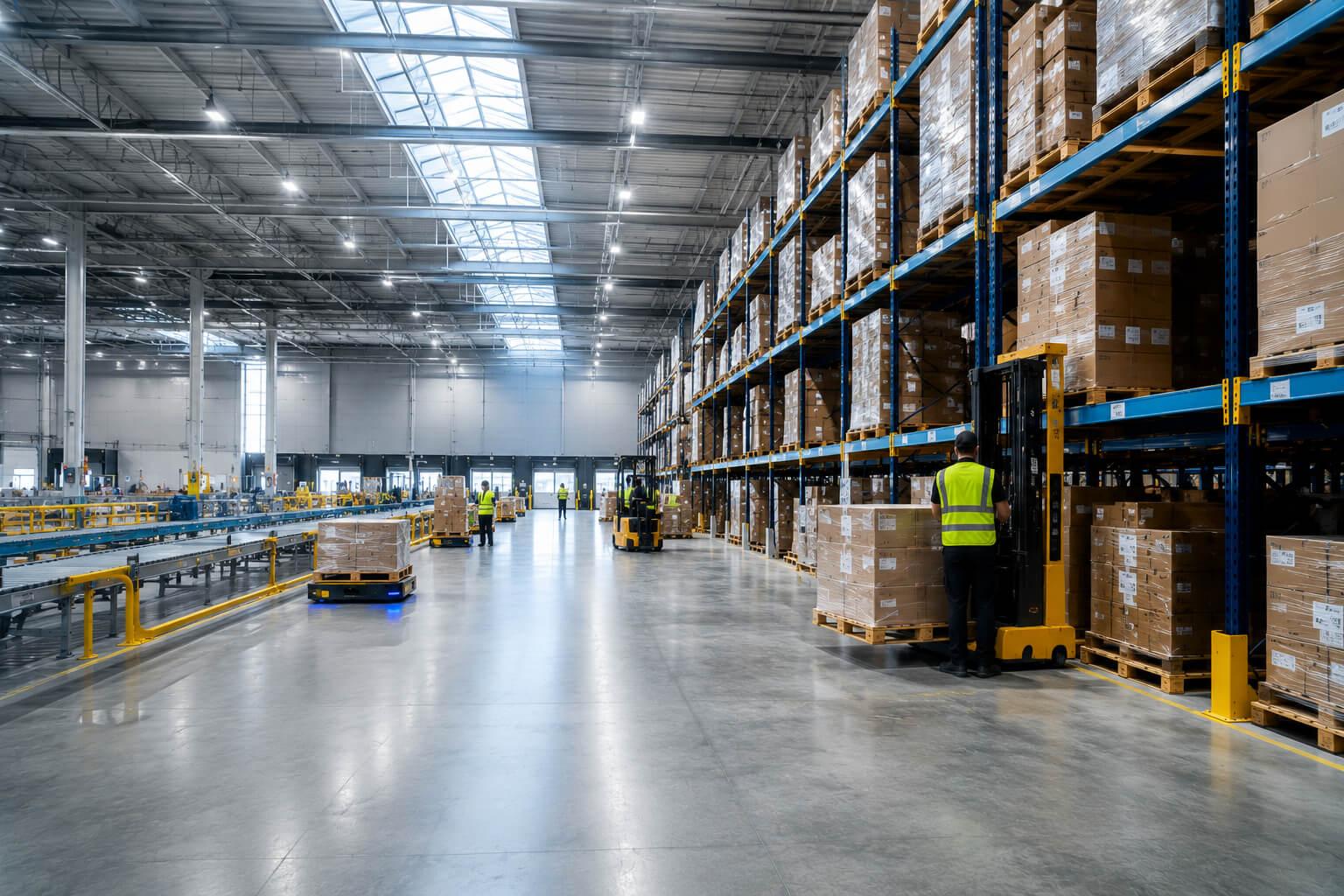
Concrete is widely used in warehouses and distribution centers, particularly in new construction and heavy-duty applications.
Potential advantages
- Suitable for many heavy-duty warehouse environments when properly designed
- Can support industrial traffic
- Compatible with a range of surface treatments
Considerations
- Cracks, joints and surface deterioration may require repair
- Flatness and levelness can be important for automated equipment
- Renovation may disrupt warehouse operations
2. Epoxy Flooring
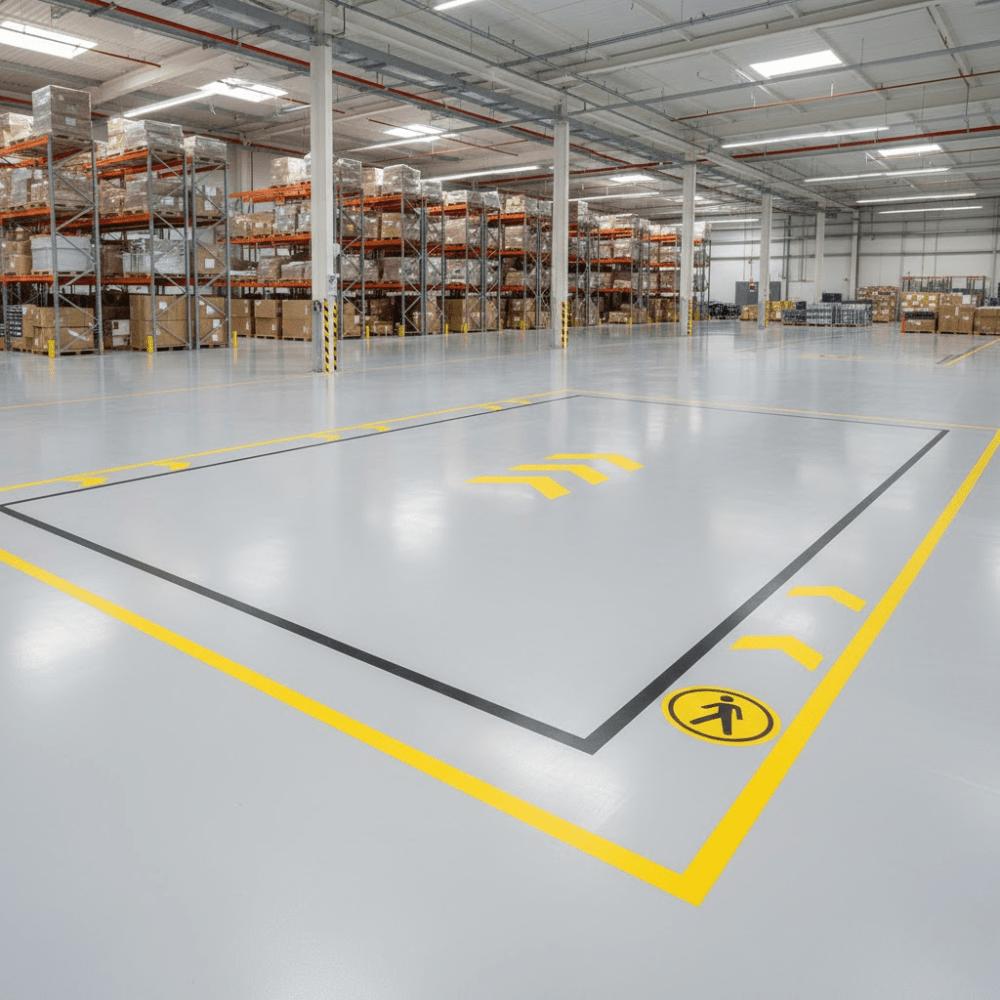
Epoxy is a resin-based coating applied to a properly prepared substrate.
Potential advantages
- Continuous finished surface
- Multiple color and marking options
- Can improve cleanability when correctly specified
Considerations
- Surface preparation is critical
- Curing time can affect the installation schedule
- Performance depends on coating thickness, formulation and substrate condition
3. Interlocking PVC Floor Tiles
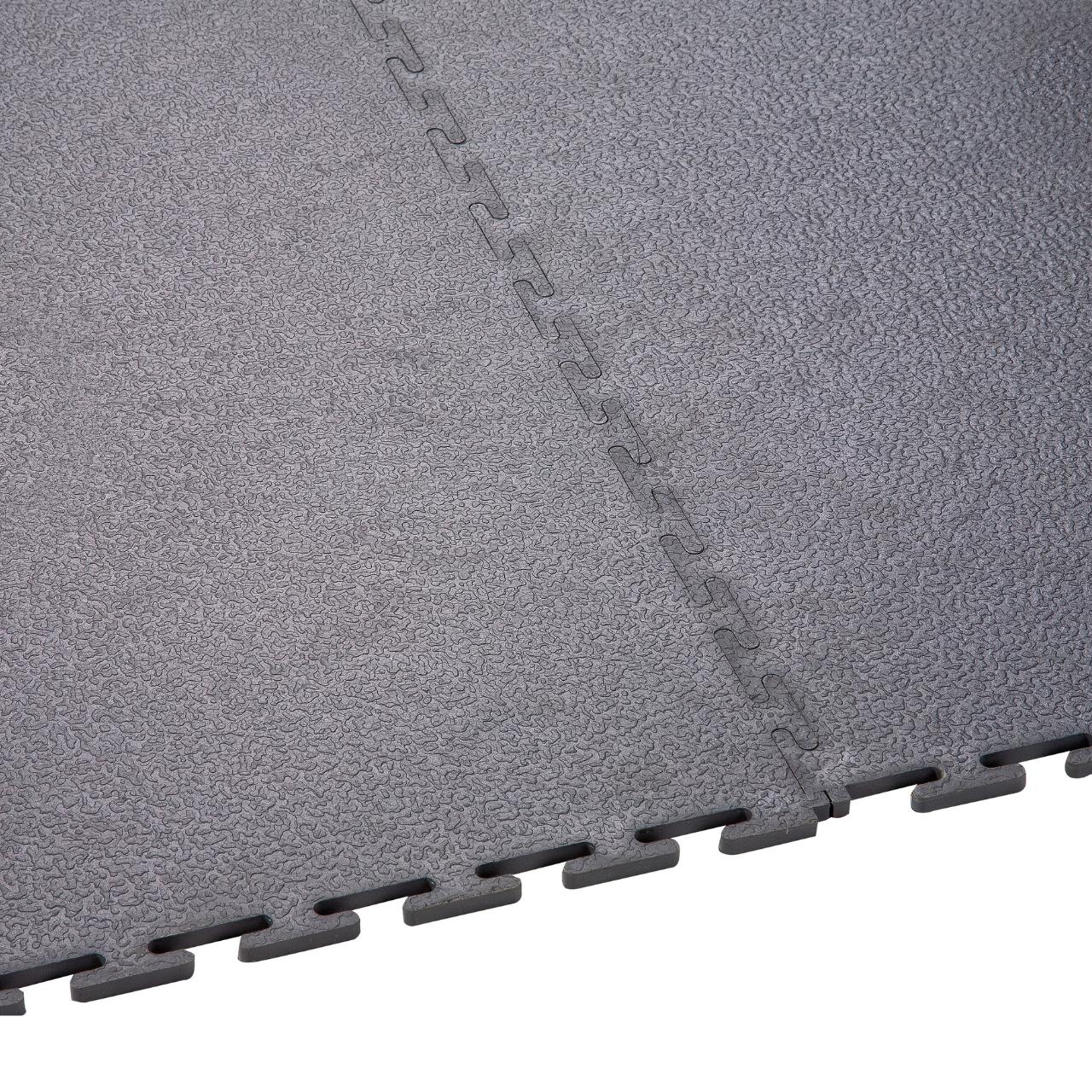
Modular PVC tiles connect through mechanical locking edges and can be considered for selected renovation and industrial applications.
Potential advantages
- Modular installation
- Potential for phased renovation
- Individual tile replacement in suitable systems
- No full-surface adhesive required for systems designed for adhesive-free installation
Considerations
- Forklift suitability must be verified
- Joint performance is important
- Floor flatness and stability remain essential
- Heavy rack and machinery loads require assessment
4. Concrete With a Suitable Surface Treatment
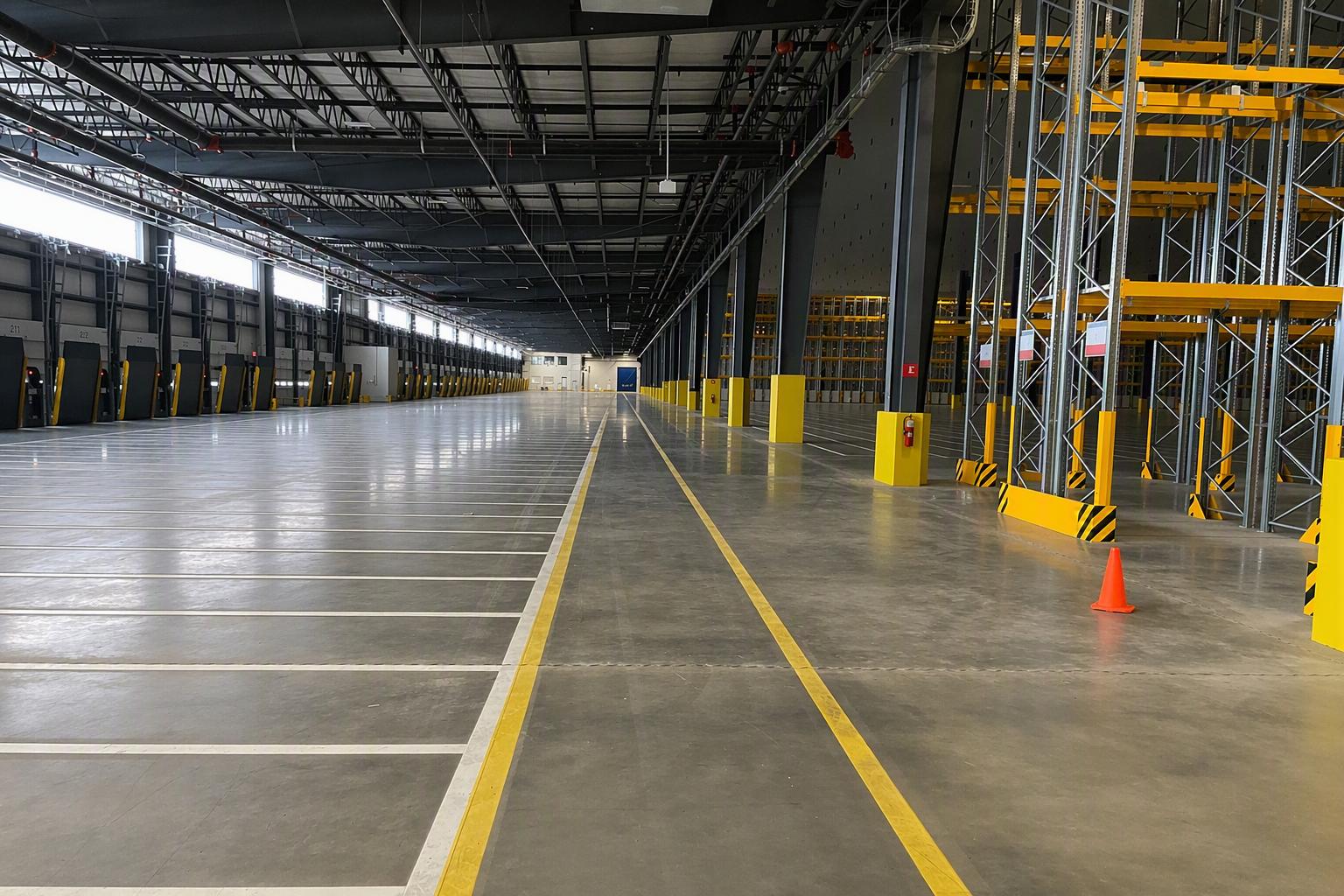
Depending on the existing slab, grinding, polishing, densification or another compatible treatment may be appropriate.
Potential advantages
- Can retain the existing concrete floor
- May improve surface condition or maintenance characteristics
- Avoids installing a separate modular covering in some applications
Considerations
- Cannot resolve every structural defect
- Results depend on the concrete's condition
- Surface treatment must match the operating environment
Flooring Comparison Table
Factor Concrete Epoxy Interlocking PVC Tiles
Heavy-duty suitability Depends on slab design and condition Depends on system and substrate Depends on tile and application
Continuous surface Yes Yes No; modular joints
Phased renovation Possible Possible, but curing and preparation matter Often practical
Localized repair Concrete repair Coating repair Individual tile replacement may be possible
Installation downtime Project-dependent Includes preparation and curing Often limited, depending on conditions
Chemical resistance Depends on concrete and treatment Formulation-dependent Formulation-dependent
Automated equipment Flatness and levelness critical Flatness and levelness critical Joint and surface tolerances must be verified
Initial cost Project-dependent Project-dependent Project-dependent
Important: This is a general comparison, not a performance certification. Evaluate the exact flooring specification, installation conditions and intended use before making a purchasing decision.
When Should an E-commerce Warehouse Consider Interlocking PVC Floor Tiles?
Interlocking PVC flooring may be worth evaluating when the project involves renovation rather than new construction, especially where installation flexibility matters.
Potential applications include:
- Selected warehouse aisles
- Packing and work areas
- Maintenance zones
- Staff workstations
- Light- to medium-duty handling areas, where the product is rated accordingly
- Industrial spaces requiring localized repair
For heavy forklift routes, concentrated rack loads or continuous high-intensity traffic, the specific PVC tile system must be validated against the actual conditions.
Why Modular Installation Can Help
Suppose a fulfillment center needs to renovate a damaged 2,000 m² work area while keeping the rest of the warehouse operational.
A modular approach may allow the project team to divide the work into manageable sections.
This can help coordinate:
1. Area preparation
2. Tile installation
3. Inspection
4. Equipment movement
5. Reopening of completed zones
The real benefit depends on installation productivity, traffic restrictions and the condition of the existing floor.
What About Forklift Aisles?
Forklift aisles generally require more rigorous evaluation than pedestrian or light-duty areas.
Before using modular PVC tiles in these zones, confirm:
- Maximum operating and payload conditions
- Wheel material and contact area
- Traffic frequency
- Turning and braking behavior
- Locking-system performance
- Tile indentation and wear data
- Substrate flatness
- Relevant manufacturer limitations
Do not approve a product for forklift traffic based only on a supplier's statement that it is “heavy duty.”
Flooring Requirements for Automated E-commerce Warehouses
Automation is an important consideration in modern fulfillment centers.
AGVs and AMRs may repeatedly travel along the same routes, while conveyors and automated storage equipment may have specific installation tolerances.
In these applications, a floor must satisfy more than basic durability requirements.
1. Flatness and Levelness
Automated equipment may require the floor to remain within defined tolerances.
The required values should come from the equipment manufacturer's specifications and project design.
2. Consistent Surface Conditions
Sudden changes in surface height, uneven joints or damaged areas can affect equipment movement.
For modular flooring, verify that tile joints and transitions are compatible with the equipment.
3. Repeated Traffic Paths
Repeated movement along fixed routes can concentrate wear in particular locations.
The selected system should be evaluated for the expected traffic cycle and wheel configuration.
4. Integration With the Warehouse Layout
Floor markings, safety zones, equipment charging areas and traffic routes may need to be coordinated with the flooring plan.
For automated facilities, obtain approval from the relevant equipment supplier and flooring manufacturer before installing modular tiles along critical travel routes.
How to Plan an E-commerce Warehouse Flooring Renovation
A successful flooring project begins with the operating requirements, not the product catalogue.
Step 1: Map the Operational Zones
Divide the facility into areas such as:
- Receiving
- Storage
- Picking
- Packing
- Sorting
- Dispatch
- Automated travel routes
- Maintenance
Different zones may require different flooring specifications.
Step 2: Identify Equipment and Loads
Record the equipment operating in each area.
Include forklift types, pallet trucks, wheel materials, rack loads and machinery loads.
Where possible, obtain actual wheel-load and point-load information rather than estimating from total weight alone.
Step 3: Inspect the Existing Floor
Document cracks, joints, unevenness, damaged coatings, moisture and contamination.
Photographs and a floor plan can help suppliers evaluate the project before recommending a solution.
Step 4: Define Safety and Compliance Requirements
Determine whether the project requires particular slip-resistance data, fire classifications, chemical-resistance information or other documentation.
Requirements may vary by country, building use and facility type.
Step 5: Set the Installation Window
Decide whether the project must be completed:
- During a planned shutdown
- Overnight
- During weekends
- In several phases
- Alongside normal operations
This will influence the choice of flooring and installation method.
Step 6: Compare Total Project Cost
Consider more than material price.
A useful framework is:
Total Cost of Ownership = Material + Substrate Preparation + Installation + Downtime + Maintenance + Repairs + Replacement
Step 7: Request Product-Specific Documentation
Before purchasing, request the relevant technical data, installation instructions, test reports and warranty terms for the exact product being offered.
Common Mistakes When Choosing E-commerce Warehouse Flooring
Mistake 1: Choosing the Lowest Price Per Square Meter
A low material price may not reflect installation costs, operational disruption or future repairs.
Mistake 2: Ignoring Equipment Details
Two warehouses with similar floor areas may have completely different requirements because of wheel types, traffic intensity and point loads.
Mistake 3: Assuming Thicker Tiles Are Always Better
Thickness alone does not establish load capacity or service life.
Mistake 4: Ignoring Automated Equipment Requirements
A surface that works for manual pallet trucks may not meet the tolerances required by an AGV or AMR.
Mistake 5: Installing Over an Unsuitable Substrate
Modular flooring still requires a suitable, stable installation surface.
Mistake 6: Overlooking Joint Performance
For interlocking PVC tiles, joint design and stability are important, particularly under repeated rolling traffic.
Mistake 7: Forgetting Operational Downtime
The best flooring option on paper may not be the most practical if installation prevents critical warehouse operations.
Frequently Asked Questions
What is the best industrial flooring for an e-commerce warehouse?
There is no universal best option. Concrete, epoxy and interlocking PVC tiles can all be considered for different applications. The decision depends on traffic, loads, floor condition, automation requirements, installation downtime and maintenance needs.
Are PVC floor tiles suitable for e-commerce fulfillment centers?
They can be suitable for selected areas, provided the specific tile system meets the operational requirements. Forklift traffic, wheel loads, point loads and automated equipment requirements should be checked carefully.
Can interlocking PVC tiles be installed over an existing warehouse floor?
Many systems can be installed over suitable hard substrates. The existing floor must meet the manufacturer's requirements for stability, flatness, moisture and cleanliness.
Can modular PVC flooring reduce warehouse downtime?
It may help because installation can often be organized in sections. Actual downtime depends on floor preparation, installation speed, site access and the manufacturer's instructions.
Are interlocking PVC tiles suitable for AGVs and AMRs?
Potentially, but not automatically. Joint transitions, surface flatness, levelness and equipment tolerances must be verified against the automation supplier's requirements.
How do I choose flooring for forklift traffic?
Evaluate the equipment's operating weight, payload, wheel load, wheel material, traffic frequency, turning and braking conditions, and the flooring system's documented performance.
How can I reduce warehouse flooring maintenance costs?
Start by selecting a system appropriate for the operating conditions. Maintain the surface, address substrate problems and traffic-related damage early, and compare lifecycle costs rather than only initial material prices.
Conclusion: Choose Warehouse Flooring Around Your Operation
The right industrial flooring for an e-commerce warehouse must support the way the facility actually operates.
For high-volume fulfillment centers, the most important considerations often include:
- Repeated material-handling traffic
- Forklift and pallet truck loads
- Rack and machinery point loads
- Automated equipment tolerances
- Workplace safety
- Installation downtime
- Maintenance and lifecycle costs
Concrete and resin systems may be appropriate for many applications. Interlocking PVC floor tiles may provide another option for selected renovation projects where modular installation and localized replacement are valuable.
The key is to match the flooring system to the actual application rather than selecting it by thickness, price or marketing claims alone.
Planning an E-commerce Warehouse Flooring Project?
We can help evaluate the flooring requirements for your warehouse, fulfillment center or distribution facility.
Send us the following information:
- Floor area: Total square meters
- Application: Storage, picking, packing, dispatch or automated handling
- Equipment: Forklifts, pallet trucks, AGVs or AMRs
- Load details: Operating weight, wheel load and point loads
- Wheel type: Rubber, PU, nylon or other
- Traffic intensity: Occasional, daily or continuous
- Existing floor: Concrete, epoxy or another surface
- Installation window: Available downtime
- Project location: Country and city
With these details, we can assess whether interlocking PVC flooring is appropriate for your project and help identify a suitable specification.
Contact us to discuss your warehouse flooring requirements and request a project-specific quotation.
Post time: Oct-10-2026