
# Industrial Vinyl Flooring vs PVC Tiles: What's the Difference and Which Is Better for Your Facility?
Choosing the right industrial flooring is an important decision for warehouses, factories, workshops, and commercial facilities. The floor must withstand daily operations, support equipment movement, provide a safe working surface, and remain easy to maintain.
Two commonly considered options are **industrial vinyl flooring and PVC floor tiles**.
Although both products are generally made from polyvinyl chloride (PVC), they differ in product structure, installation methods, maintenance requirements, and application suitability.
So, what is the difference between industrial vinyl flooring and PVC tiles? And which option is better for your project?
In this guide, we compare their key features to help facility managers, contractors, distributors, and industrial flooring buyers make an informed decision.
## 1. What Is Industrial Vinyl Flooring?
Industrial vinyl flooring is a general category of resilient flooring products made primarily from PVC materials.
It is available in different formats, including:
- Vinyl flooring rolls (sheet vinyl)
- Homogeneous vinyl flooring
- Heterogeneous vinyl flooring
- Luxury Vinyl Tiles (LVT)
- Commercial and industrial vinyl planks
Depending on the product construction, industrial vinyl flooring can offer a relatively seamless surface, good wear resistance, easy cleaning, and a range of decorative finishes.
**Common applications include:**
- Commercial buildings
- Healthcare facilities
- Laboratories
- Light industrial areas
- Offices and public buildings
- Clean and controlled environments
Vinyl flooring rolls are often selected when a continuous floor surface with minimal visible joints is required.
However, the suitability of a particular vinyl product for heavy industrial traffic depends on its thickness, wear layer, construction, installation method, and tested performance.
## 2. What Are Industrial PVC Floor Tiles?
Industrial PVC floor tiles are modular flooring products manufactured from PVC materials.
Unlike traditional vinyl rolls, PVC tiles are supplied as individual square or rectangular units.
They can be designed with different installation systems:
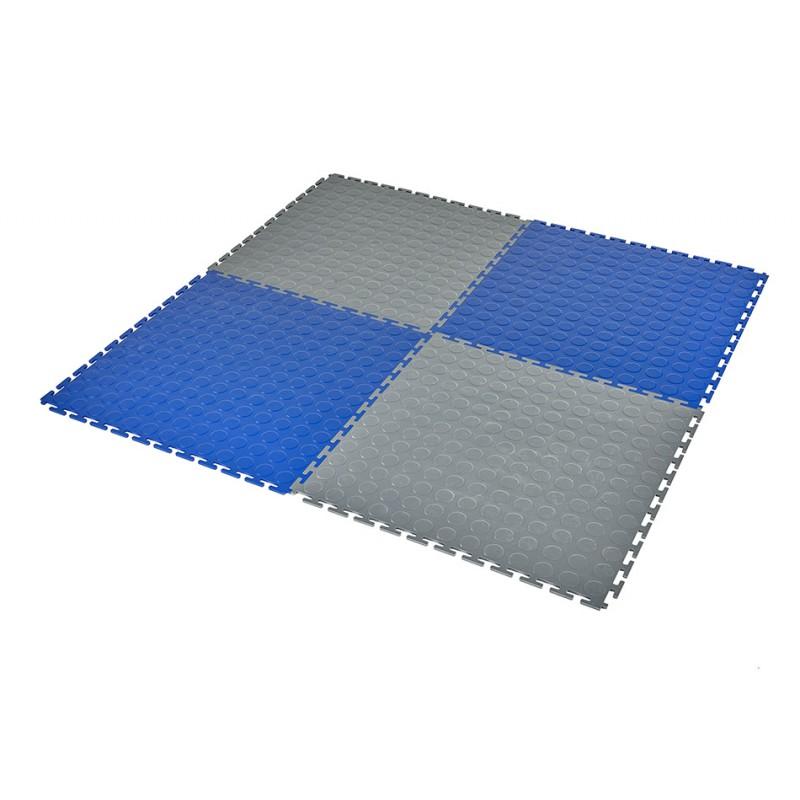
- Interlocking PVC floor tiles
- Glue-down PVC tiles
- Loose-lay PVC tiles
Among these options, interlocking PVC floor tiles are particularly useful for industrial environments where flexible installation and localized maintenance are important.
For example, NAMA RUBBER offers industrial interlocking PVC floor tiles designed for warehouses, factories, workshops, and other demanding working environments.
Typical product options include:
- 500 × 500 mm or 510 × 510 mm formats
- Different thickness options, depending on the model
- Coin, diamond, and textured surface patterns
- Multiple color options
- Modular interlocking connections
**Common applications include:**
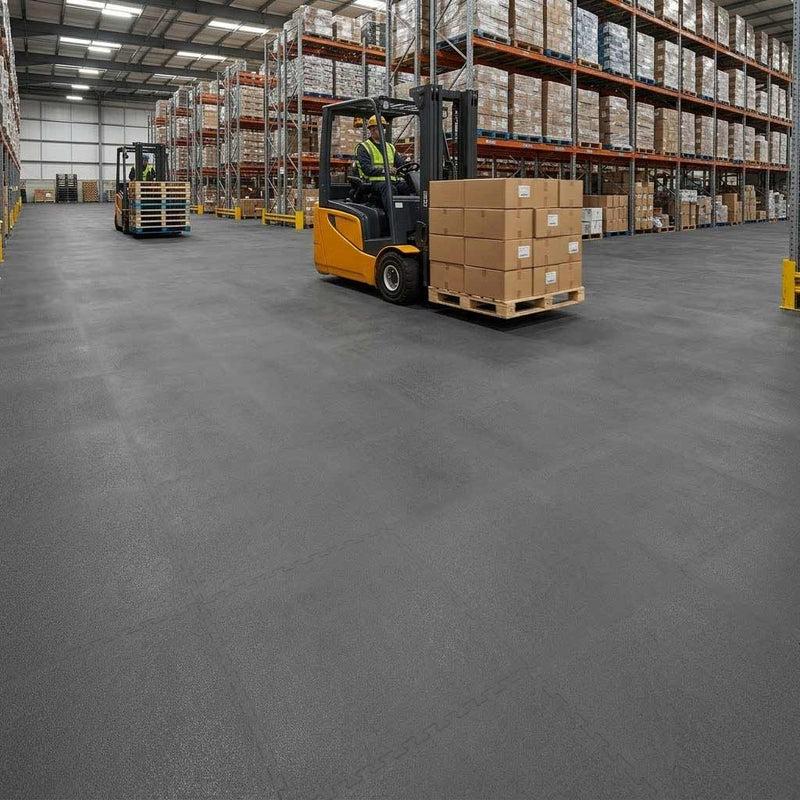
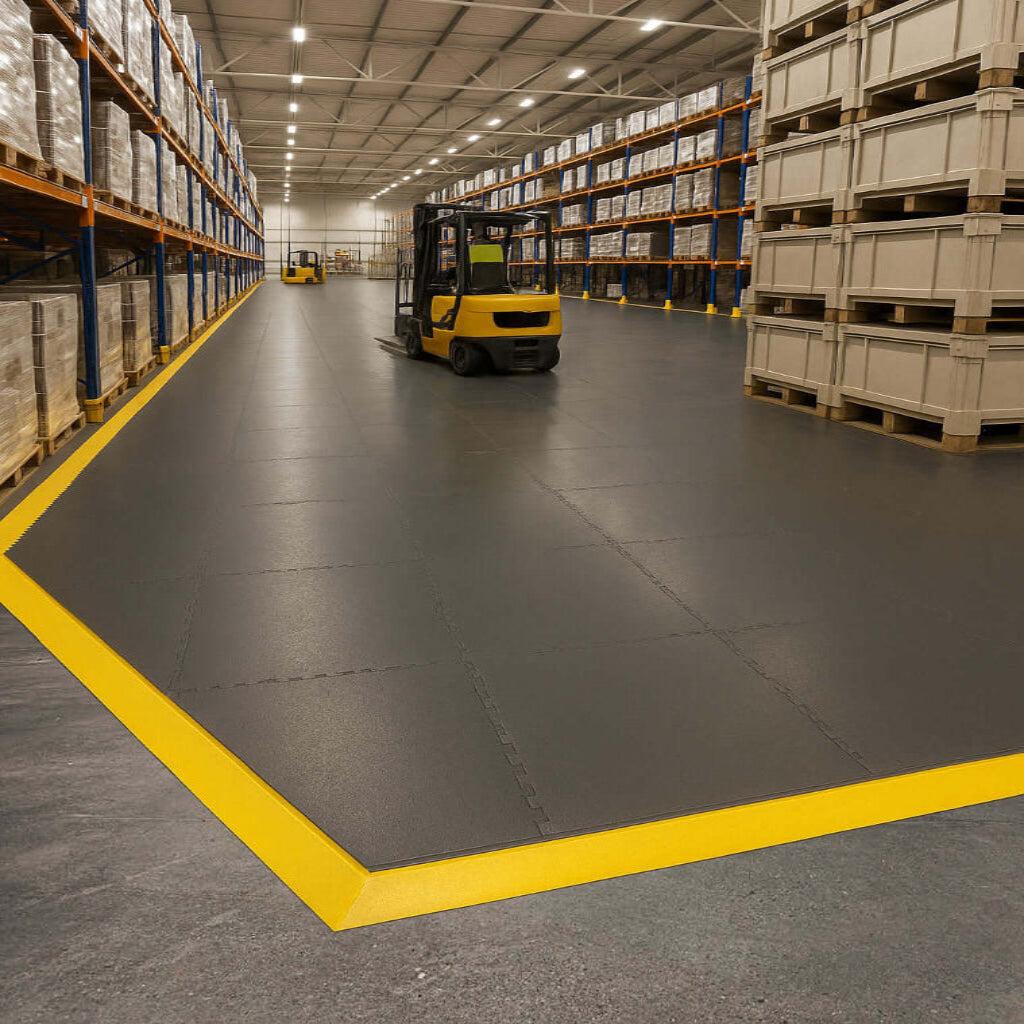
- Warehouses and distribution centers
- Manufacturing facilities
- Industrial workshops
- Automotive service areas
- Storage and logistics facilities
- Equipment operating areas
The modular design allows individual damaged tiles to be replaced without removing the entire floor.
## 3. Industrial Vinyl Flooring vs PVC Tiles: Key Differences
Although both products use PVC-based materials, their practical differences can be significant.
### Comparison Table
| Comparison | Industrial Vinyl Flooring | Interlocking PVC Tiles |
|---|---|---|
| Product format | Rolls, sheets, planks or tiles | Individual modular tiles |
| Installation | Glue-down or other specified systems | Mechanical interlocking |
| Surface appearance | Usually continuous | Visible modular joints |
| Installation flexibility | Depends on product | High |
| Localized replacement | May require cutting and patching | Individual tile replacement |
| Subfloor requirements | Depends on installation system | Requires a suitable, stable and reasonably level base |
| Maintenance | Cleaning and surface maintenance | Cleaning and individual tile replacement |
| Heavy equipment traffic | Depends on product specification | Depends on thickness, material and load testing |
| Installation downtime | Depends on adhesive and preparation | Often suitable for faster modular installation |
| Customization | Colors and patterns vary | Different colors and patterns can be combined |
The most important difference is not simply the material itself, but the flooring system and how it is installed and maintained.
## 4. Installation: Vinyl Rolls vs Interlocking PVC Tiles
Installation requirements can have a significant impact on project costs and operational downtime.
### Industrial Vinyl Flooring Installation
Traditional vinyl sheet flooring generally requires:
1. Preparing and leveling the subfloor.
2. Cleaning and removing dust or contaminants.
3. Applying the specified flooring adhesive.
4. Positioning and joining the vinyl sheets.
5. Rolling the surface to ensure proper bonding.
6. Allowing the adhesive to cure according to manufacturer instructions.
The process may require professional installation, particularly for large commercial or industrial areas.
### Interlocking PVC Tile Installation
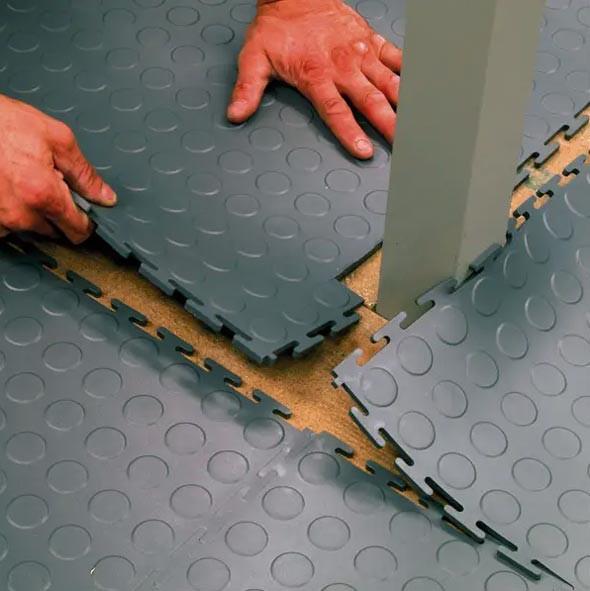
Interlocking PVC tiles use a modular connection system.
A typical installation process includes:
1. Cleaning and inspecting the existing concrete floor.
2. Planning the installation layout.
3. Positioning the first tile.
4. Connecting adjacent tiles through their interlocking edges.
5. Cutting tiles around columns, walls, and other obstacles.
6. Installing optional edge and corner accessories where required.
In suitable conditions, interlocking PVC tiles can be installed without full-surface adhesive.
This can reduce installation complexity and make future maintenance easier.
However, the installation method should always follow the product manufacturer's recommendations and project requirements.
## 5. Which Flooring Is Better for Forklift and Heavy Equipment Traffic?
This is one of the most important questions for warehouse and factory flooring buyers.
Industrial facilities may experience:
- Repeated forklift movements
- Pallet truck operations
- Heavy machinery movement
- Concentrated loads from equipment legs
- Frequent turning and braking
- Continuous rolling traffic
Not all vinyl flooring products are designed for these conditions.
Traditional vinyl sheet flooring may be suitable for certain industrial environments, but its performance under concentrated wheel loads and repeated heavy equipment movements must be verified.
Industrial interlocking PVC tiles offer a modular alternative.
However, selecting the correct product requires more than simply choosing a thicker tile.
Before purchasing flooring for forklift applications, evaluate:
**1. Forklift weight and actual wheel loads**
The total vehicle weight alone does not determine the load applied to each wheel.
**2. Wheel material and dimensions**
Polyurethane, rubber, and hard nylon wheels can create different contact pressures.
**3. Dynamic rolling loads**
Repeated movement, turning, and braking may place additional stress on the flooring.
**4. Tile thickness and material composition**
Different PVC formulations and tile constructions can produce different mechanical performance.
**5. Interlocking connection strength**
The locking system must be suitable for the expected operating conditions.
**6. Concrete subfloor condition**
The existing concrete floor should be stable, sufficiently strong, and suitable for the intended flooring installation.
For heavy-duty applications, request relevant test reports and evaluate performance under conditions that match the actual equipment and operating environment.
## 6. Maintenance and Repair: Which Is More Convenient?
Maintenance is another important consideration when comparing industrial vinyl flooring and PVC tiles.
### Vinyl Flooring
If traditional vinyl sheet flooring becomes damaged, repair may involve:
- Cutting out the damaged section
- Preparing the replacement material
- Applying compatible adhesive
- Joining and finishing the repaired area
Depending on the damage and installation method, repairs may require professional labor.
### Interlocking PVC Tiles
Interlocking PVC tiles offer a more modular maintenance approach.
If an individual tile becomes damaged, it may be possible to:
- Disconnect or remove the affected tile.
- Inspect the underlying concrete.
- Replace it with a matching tile.
- Reconnect the surrounding flooring.
This can help reduce the scope of localized repairs and avoid replacing an entire floor section.
For facilities that want to maintain operations while carrying out localized floor repairs, modular PVC flooring can be a practical option.
## 7. Chemical Resistance and Oil Resistance
Industrial floors may come into contact with:
- Lubricating oils
- Hydraulic fluids
- Cleaning chemicals
- Industrial detergents
- Coolants and other process liquids
Chemical resistance should not be assumed simply because a flooring product is made from PVC.
Different formulations, surface finishes, and chemical concentrations can affect performance.
When evaluating either vinyl flooring or PVC tiles, consider:
- The specific chemicals involved
- Chemical concentration
- Contact temperature
- Exposure duration
- Cleaning procedures
- Manufacturer chemical resistance data
For automotive workshops, maintenance facilities, and manufacturing plants, always request compatibility information for the actual chemicals used in the working environment.
## 8. Cost Comparison: Industrial Vinyl Flooring vs PVC Tiles
The total cost of an industrial flooring project includes more than the initial material price.
Consider the following factors:
| Cost Factor | Vinyl Flooring | Interlocking PVC Tiles |
|---|---|---|
| Material cost | Depends on product grade | Depends on material, thickness and design |
| Installation labor | May require specialized installation | Often simpler modular installation |
| Adhesive cost | Applicable to adhesive systems | May not be required |
| Installation downtime | Depends on installation and curing | Often shorter in suitable conditions |
| Repair cost | Depends on repair scope | Individual tile replacement may be possible |
| Long-term maintenance | Depends on product and application | Depends on tile durability and operating conditions |
For large projects, the best purchasing decision should be based on total installed cost and expected maintenance requirements rather than material price alone.
## 9. How to Choose the Right Flooring for Your Application
There is no single flooring solution suitable for every industrial environment.
The best choice depends on how the floor will be used.
### Choose Industrial Vinyl Flooring When:
- You need a continuous surface with minimal visible joints.
- The facility has relatively controlled traffic conditions.
- Hygiene and ease of cleaning are important.
- You prefer a sheet or plank flooring format.
- The selected product meets your specific industrial performance requirements.
### Choose Interlocking PVC Floor Tiles When:
- You need a modular flooring system.
- Installation flexibility is important.
- You want to avoid full-surface adhesive installation where permitted.
- Localized tile replacement is a priority.
- Your warehouse or workshop requires a practical industrial flooring solution.
- You need to combine different colors for traffic lanes and working zones.
For warehouses with forklift operations, make sure the selected tile has suitable performance data for the actual wheel loads and operating conditions.
## 10. NAMA RUBBER Industrial Interlocking PVC Floor Tiles
NAMA RUBBER specializes in rubber and PVC flooring solutions for industrial, commercial, and fitness applications.
Our industrial interlocking PVC flooring range is developed for facilities that need modular installation, practical maintenance, and flexible flooring configurations.
**Key product features:**
- Material: PVC
- Product format: Interlocking floor tiles
- Available thicknesses: 5 mm, 6 mm, 7 mm, 8 mm and 10 mm, depending on model
- Surface patterns: Coin, diamond and textured
- Standard sizes: 500 × 500 mm and selected 510 × 510 mm models
- Color options: Black, gray, dark gray, yellow and other available colors
- Applications: Warehouses, factories, workshops and industrial facilities
We support OEM and wholesale supply for international distributors, contractors, and industrial flooring buyers.
For projects involving forklifts or heavy equipment, we recommend evaluating the specific tile model against the actual operating conditions before confirming product selection.
**Explore our industrial PVC flooring range:**
https://www.namarubber.com/interlocking-pvc-flooring-tiles.html
## 11. Frequently Asked Questions
Q1: Is industrial vinyl flooring the same as PVC flooring?
Not exactly. Vinyl flooring is a broad product category, and PVC is the main polymer used in many vinyl flooring products. Industrial PVC tiles are one type of PVC-based flooring.
Q2: Are PVC tiles better than vinyl rolls for warehouses?
It depends on the warehouse requirements. Interlocking PVC tiles offer modular installation and individual tile replacement, while vinyl rolls provide a more continuous surface. For forklift applications, compare the tested load performance of the specific products.
Q3: Can interlocking PVC tiles be installed without glue?
Many interlocking PVC tiles are designed for mechanical installation without full-surface adhesive. However, installation requirements depend on the product design, floor condition, and application.
Q4: Can forklifts drive on interlocking PVC tiles?
Some industrial PVC tiles are designed for equipment traffic, but suitability depends on the tile construction, thickness, wheel loads, wheel materials, turning movements, and locking strength. Always verify the relevant test data before installation.
Q5: Can damaged PVC floor tiles be replaced individually?
Yes. One of the main advantages of modular interlocking PVC flooring is that individual damaged tiles can generally be removed and replaced without removing the entire flooring system.
Q6: What thickness of PVC tiles is suitable for industrial warehouses?
Common industrial options include 5 mm, 6 mm, 7 mm, 8 mm and 10 mm. The appropriate thickness depends on the application, traffic intensity, load conditions, and product construction. Thicker does not automatically mean more suitable.
Q7: Are industrial PVC tiles resistant to oil and chemicals?
PVC flooring can offer resistance to certain oils and chemicals, but performance varies by formulation. Always check chemical compatibility with the specific substances used at your facility.
Conclusion: Choose Flooring Based on Your Operating Conditions
Industrial vinyl flooring and interlocking PVC tiles both have their place in modern industrial environments.
Vinyl rolls are suitable when a continuous surface is the priority, while interlocking PVC tiles offer advantages in modular installation, localized maintenance, and flexible floor layouts.
For warehouses, factories, and workshops, the right choice should be based on actual traffic conditions, equipment loads, maintenance expectations, and installation requirements.
Looking for a reliable industrial PVC flooring supplier?
Contact NAMA RUBBER to discuss your project requirements, request product specifications, and explore OEM and wholesale flooring solutions.
Website: https://www.namarubber.com/
Post time: Nov-11-2026