
Oil-Resistant Industrial Floor Tiles: Choosing the Right Flooring for Oil-Contaminated Environments
Oil spills are a common challenge in many industrial environments. Automotive workshops, machinery factories, maintenance facilities, and warehouses often deal with lubricating oils, hydraulic fluids, grease, and other petroleum-based substances.
These materials can affect flooring surfaces, create slippery conditions, and increase cleaning and maintenance requirements.
Choosing the right oil-resistant industrial floor tiles is therefore an important part of maintaining a practical and safe working environment.
But what makes industrial flooring suitable for oil-exposed areas? Are interlocking PVC floor tiles a good option for workshops and factories? What should buyers consider before placing an order?
This guide explores the key factors involved in selecting industrial flooring for environments where oil exposure is part of daily operations.
1. What Are Oil-Resistant Industrial Floor Tiles?
Oil-resistant industrial floor tiles are flooring products designed or selected to withstand exposure to specified oils and lubricants without unacceptable deterioration.
Depending on the material and formulation, industrial flooring may be exposed to:
Lubricating oils.
Hydraulic oils.
Engine oils.
Gear oils.
Industrial greases.
Cutting and machining fluids.
Selected petroleum-based maintenance products.
Oil resistance is not a universal property shared by all flooring materials.
Different polymers and flooring formulations react differently to petroleum-based substances. Some materials may experience swelling, softening, discoloration, surface degradation, or changes in mechanical performance after prolonged contact.
For this reason, oil compatibility should always be evaluated against the exact oil type, formulation, temperature, and exposure duration.
An industrial floor that works well in a dry warehouse may not necessarily be suitable for an oil-contaminated workshop.
2. Why Is Oil Resistance Important for Industrial Flooring?
Oil exposure creates several practical challenges for industrial facilities.
2.1 Prevent Premature Flooring Deterioration
Certain oils and petroleum-based fluids can interact with flooring materials and gradually affect their properties.
Incompatible materials may swell, soften, stain, or lose their original performance.
Selecting a flooring system with verified compatibility can help reduce the risk of premature deterioration.
2.2 Improve Cleaning and Maintenance
Oil and grease can accumulate around machinery, maintenance stations, and production equipment.
A suitable flooring surface should be compatible with the cleaning agents and maintenance procedures used by the facility.
Regular cleaning is important to prevent oil buildup and maintain an appropriate working environment.
2.3 Reduce Slip Hazards
Oil contamination can significantly change the friction between footwear and the floor surface.
Even a flooring material with good dry slip performance may become slippery when covered with oil.
Therefore, oil resistance and slip resistance must be evaluated separately.
The surface texture, oil accumulation, cleaning frequency, footwear, and working conditions all influence slip risk.
2.4 Support Industrial Maintenance Operations
Industrial facilities often need to maintain production equipment without extensive floor renovation.
A modular flooring system may offer practical localized maintenance options where individual tiles can be replaced.
However, the complete flooring system must be appropriate for the equipment loads and operating conditions.
3. Which Industrial Environments Need Oil-Resistant Flooring?
Oil-resistant flooring may be considered for several types of industrial applications.
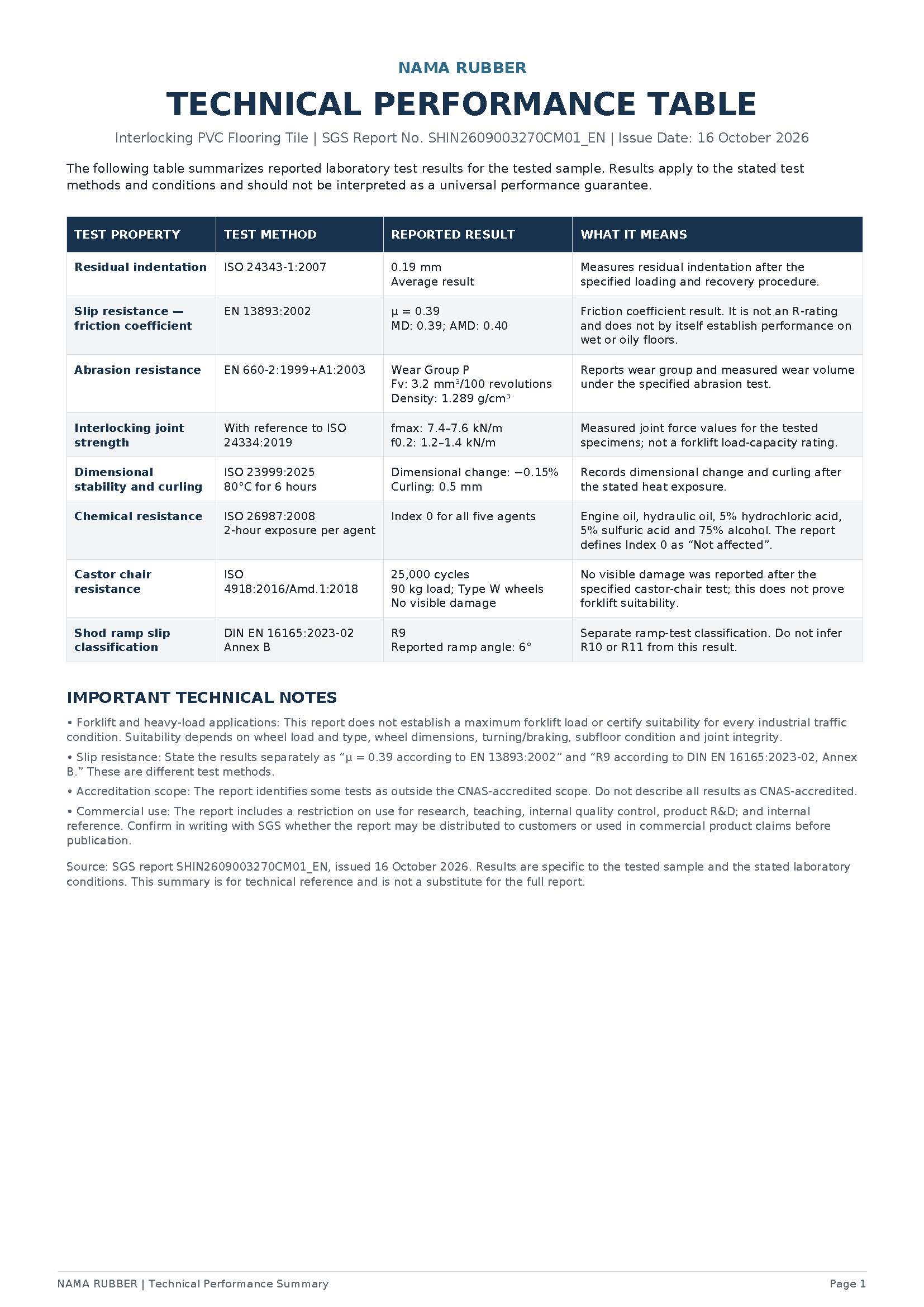
3.1 Automotive Workshops and Garages
Automotive repair facilities regularly handle engine oil, transmission fluid, lubricants, grease, and other vehicle maintenance products.
Flooring selection should consider:
Occasional or repeated oil spills.
Vehicle and equipment loads.
Tool impact and abrasion.
Cleaning chemicals.
Slip resistance under contaminated conditions.
Interlocking PVC tiles may be considered for selected workshop applications when their oil compatibility and mechanical performance are verified.
3.2 Machinery and Manufacturing Workshops
Manufacturing facilities may use hydraulic systems, lubricants, cutting fluids, and industrial machinery oils.
These substances can come into contact with flooring during routine production and maintenance.
The flooring material should be evaluated against the specific fluids used by the machinery.
For areas with continuous oil leakage or frequent chemical exposure, a specialized industrial flooring system may be more appropriate.
3.3 Industrial Warehouses
Some warehouses store machinery, automotive components, lubricants, and industrial equipment.
Oil exposure may occur around loading areas, maintenance zones, or equipment parking locations.
In addition to oil compatibility, warehouse flooring must account for:
Forklift wheel loads.
Pallet truck movements.
Turning and braking forces.
Joint stability.
Existing concrete floor conditions.
For these applications, flooring thickness alone is not enough to determine suitability.
3.4 Equipment Maintenance Areas
Maintenance stations often experience concentrated exposure to oils, grease, and cleaning products.
A suitable flooring system should support routine maintenance activities and allow practical cleaning.
Where spills are frequent, consider whether a modular tile system or a continuous chemical-resistant floor provides better protection.
3.5 Industrial Production Facilities
Factories using hydraulic equipment, conveyors, motors, and automated production lines may experience occasional oil contamination.
The correct flooring solution depends on the type of machinery, expected spill frequency, operating temperature, and cleaning procedures.
4. Interlocking PVC Tiles for Oil-Exposed Industrial Areas
Interlocking PVC floor tiles are a modular flooring option used in selected industrial environments.
They connect through mechanical locking edges to form a continuous tiled surface.
Depending on the product design and application, potential advantages include:
Modular Installation
Interlocking tiles can be installed piece by piece, allowing the flooring layout to be adapted to different areas.
Localized Replacement
If an individual tile becomes damaged, it may be possible to replace the affected section rather than the entire floor.
The practicality of replacement depends on the installation layout and accessibility.
Multiple Surface Patterns
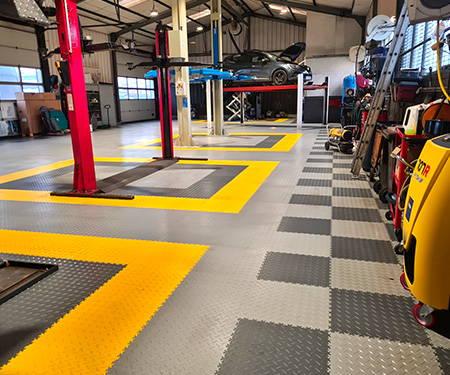
Industrial PVC tiles are available with different surface patterns, including:
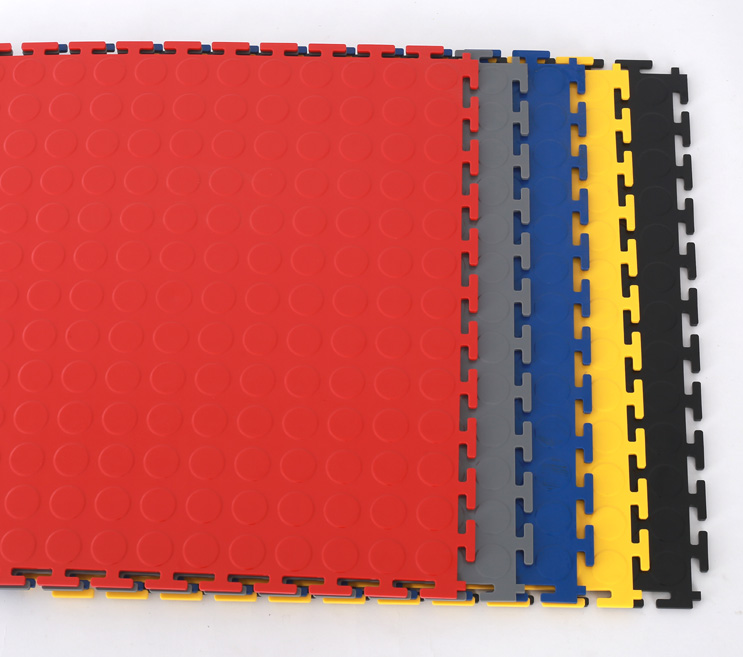
Coin pattern.
Diamond pattern.
Textured surface patterns.
Other industrial tread designs.
Surface selection should consider cleaning requirements, footwear traction, and the actual operating environment.
A patterned surface does not automatically guarantee oil-resistant or anti-slip performance.
Flexible Color Options
Common industrial colors include:
Dark gray.
Blue.
Black.
Red.
Green.
Different colors can help distinguish production areas, storage zones, maintenance stations, and pedestrian walkways.
Potential for Existing Floor Renovation
Interlocking PVC tiles may be considered when upgrading suitable existing concrete floors.
Before installation, inspect the substrate for cracks, moisture, unevenness, and contamination.
Oil contamination on the concrete must be properly addressed because it may affect installation stability and the performance of the flooring system.
Important: Standard interlocking PVC tiles should not automatically be considered oil-proof or suitable for prolonged oil immersion. Always verify product-specific compatibility.
5. Coin Pattern vs. Diamond Pattern Industrial PVC Tiles
Surface pattern is another consideration when selecting industrial floor tiles.
Coin-pattern PVC tiles feature regularly distributed circular raised designs.
Potential characteristics include:
A distinctive industrial appearance.
A relatively uniform surface pattern.
Suitability for selected warehouse and workshop applications.
Multiple color options.
Diamond-pattern PVC tiles feature raised diamond-shaped or directional tread designs.
Potential characteristics include:
A traditional industrial flooring appearance.
A textured surface design.
Suitability for selected workshop and production environments.
A visual distinction between different working zones.
The best pattern depends on the actual application, cleaning method, and verified slip performance.
Neither pattern should be assumed to provide superior oil resistance without product-specific testing.
6. Oil-Resistant PVC Tiles vs. Other Industrial Flooring Materials
Different flooring materials offer different advantages depending on the environment.
Flooring Type
Key Characteristics
Important Considerations
Interlocking PVC Tiles
Modular design and localized replacement options
Oil compatibility and tile joints require evaluation
Epoxy Flooring
Continuous bonded surface
Chemical resistance depends on the resin formulation
Polyurethane Flooring
Available in systems designed for demanding industrial environments
Performance varies by formulation
Rubber Flooring
Resilient surface with different grades and formulations
Some rubber compounds may swell or deteriorate when exposed to petroleum oils
Specialized Chemical-Resistant Flooring
Designed for defined chemical exposure conditions
Requires application-specific specification
There is no single flooring material suitable for every industrial environment.
For facilities with occasional, controlled oil exposure, compatible modular PVC flooring may be worth evaluating.
For environments with continuous oil contact, heavy contamination, or strict liquid containment requirements, a specialist flooring system may be a better choice.
7. How to Evaluate Oil Resistance Before Buying
Before selecting oil-resistant industrial floor tiles, buyers should understand the actual exposure conditions.
Step 1: Identify the Oil Type
Different oils have different chemical compositions.
Identify whether the facility uses:
Mineral-based lubricating oils.
Synthetic engine oils.
Hydraulic fluids.
Gear oils.
Cutting oils.
Greases and petroleum-based maintenance products.
Avoid treating all oils as chemically identical.
Step 2: Determine Exposure Frequency
There is a significant difference between occasional splashes and continuous contact.
Record whether oil exposure is:
Occasional.
Repeated during normal operations.
Concentrated around machinery.
Continuous or prolonged.
Step 3: Check Temperature Conditions
Oil temperature can influence its interaction with flooring materials.
Hot lubricants and heated process fluids may create different exposure conditions from oil at normal room temperature.
Step 4: Request Compatibility Information
Ask the flooring supplier for product-specific oil resistance information.
The assessment should identify:
The exact flooring model.
The oil or lubricant tested.
Exposure temperature.
Contact duration.
Observed changes in the flooring material.
Step 5: Conduct Testing if Necessary
For critical applications, request a controlled compatibility test using representative flooring samples and the actual oil used at the facility.
Evaluate changes such as:
Weight or dimensional changes.
Swelling.
Softening.
Surface discoloration.
Cracking.
Changes in mechanical properties.
Use an agreed testing method and acceptance criteria.
Step 6: Evaluate the Complete Flooring System
Do not focus only on the PVC tile surface.
Consider:
Interlocking joints.
Perimeter edges.
Ramps and transitions.
Subfloor condition.
Potential liquid penetration.
Cleaning and maintenance procedures.
Oil can pass through joints and accumulate beneath modular flooring.
Where liquid containment is required, a continuous flooring system may be more suitable.
8. Oil Resistance and Slip Resistance: Two Different Requirements
One of the most important considerations in industrial flooring is understanding the difference between oil resistance and slip resistance.
Oil resistance refers to the ability of the flooring material to withstand contact with specified oils without unacceptable deterioration.
Slip resistance refers to the ability of the floor surface to provide adequate traction under defined test conditions.
A flooring material may resist oil exposure but still become slippery when oil accumulates on its surface.
Similarly, a textured floor does not automatically guarantee adequate traction in contaminated conditions.
Industrial buyers should evaluate:
Oil compatibility.
Slip resistance under relevant conditions.
Cleaning frequency.
Surface texture.
Footwear and vehicle traffic.
Applicable safety requirements.
If the facility regularly handles oils or lubricants, consider how spills will be detected, contained, and cleaned.
9. Installation and Maintenance of Industrial PVC Floor Tiles
Correct installation and maintenance are essential for the long-term performance of modular industrial flooring.
Prepare the Concrete Subfloor
The existing concrete should be inspected before installation.
Remove oil, grease, loose materials, and other contamination according to the flooring manufacturer's requirements.
Check for significant unevenness, cracks, and moisture issues.
Check Tile Connections
Ensure that the interlocking edges are properly connected and that the flooring is installed according to the manufacturer's instructions.
Joint stability is particularly important in areas exposed to rolling equipment and repeated turning movements.
Establish a Cleaning Procedure
Use cleaning agents approved for the specific PVC formulation.
Avoid aggressive solvents or unapproved degreasers that may damage the flooring surface.
Clean oil spills promptly and follow appropriate workplace safety procedures.
Inspect High-Exposure Areas
Pay special attention to machinery locations, vehicle parking areas, and maintenance stations.
Look for:
Swelling.
Discoloration.
Softening.
Joint separation.
Surface damage.
Replace damaged tiles where appropriate and investigate the cause of deterioration before installing replacements.
10. What Determines the Cost of Oil-Resistant Industrial Floor Tiles?
The cost of an industrial flooring project depends on several factors.
Product specifications
PVC formulation.
Tile thickness.
Tile dimensions.
Surface pattern.
Color.
Project requirements
Total flooring area.
Subfloor preparation.
Installation method.
Edge profiles and accessories.
Mechanical load requirements.
Oil exposure requirements
Type of oil.
Exposure frequency.
Required compatibility documentation.
Testing requirements.
Logistics
Packaging.
Order quantity.
Shipping destination.
International freight.
Import duties and local delivery.
When comparing suppliers, buyers should evaluate the total flooring solution rather than choosing exclusively by price per square meter.
A product that is incompatible with the oils used in a facility may create additional replacement and maintenance costs.
11. How to Choose a Reliable Industrial PVC Flooring Supplier
When sourcing industrial floor tiles, consider the following questions:
What is the exact PVC formulation and product model?
Is the product compatible with the oils used at our facility?
Can the supplier provide product-specific compatibility information?
What tile thicknesses and dimensions are available?
Is the flooring designed for pedestrian traffic, pallet trucks, or forklifts?
What mechanical performance data is available?
Are slip-resistance test reports available?
How should the existing concrete floor be prepared?
Can individual tiles be replaced?
Are samples available for evaluation?
A professional supplier should be transparent about documented performance, application limitations, and the difference between general product characteristics and verified test results.
12. NAMA RUBBER Industrial Interlocking PVC Flooring Solutions
NAMA RUBBER supplies industrial PVC flooring options for warehouses, factories, workshops, and commercial facilities.
Our industrial interlocking PVC tiles are designed as modular flooring solutions for selected applications where practical installation and maintenance are important considerations.
Available product options can be evaluated according to:
Required tile thickness.
Tile dimensions.
Coin, diamond, and other surface patterns.
Industrial color requirements.
Project quantity.
Installation conditions.
For oil-exposed environments, we recommend confirming the compatibility of the specific PVC product with the actual oils and lubricants used at the facility.
For projects involving forklifts or pallet trucks, mechanical loads, wheel movements, and joint stability should also be evaluated.
Explore our Industrial Interlocking PVC Flooring Tiles to learn more about our product range.
Request an Industrial Flooring Quotation
To help us understand your project, please provide:
Application: warehouse, factory, garage, or workshop.
Total project area in square meters.
Required tile thickness.
Preferred surface pattern and color.
Type of oil or lubricant used.
Frequency of oil exposure.
Forklift or pallet truck traffic details.
Destination country.
Our team can review your requirements and help identify suitable industrial PVC flooring options.
Conclusion: Choose Flooring Based on Real Operating Conditions
Oil-resistant industrial floor tiles are an important consideration for workshops, manufacturing facilities, equipment maintenance areas, and warehouses.
However, oil resistance should never be assumed based on material type alone.
The actual performance depends on the PVC formulation, oil composition, temperature, exposure duration, and maintenance procedures.
For selected industrial applications, interlocking PVC floor tiles may offer a modular alternative to traditional flooring systems.
Before making a purchase, verify oil compatibility, slip resistance, mechanical performance, and installation requirements.
Looking for industrial PVC flooring for your next project? Contact NAMA RUBBER to discuss your application and technical requirements.
Frequently Asked Questions
1. Are PVC floor tiles resistant to oil?
Some PVC formulations may be compatible with selected oils and lubricants. However, resistance varies according to the formulation and exposure conditions. Always confirm compatibility with the specific product.
2. Can engine oil damage PVC flooring?
Certain PVC formulations may tolerate contact with specific engine oils, while others may experience swelling, staining, or softening after prolonged exposure. Product-specific compatibility should be verified.
3. Are interlocking PVC tiles suitable for automotive workshops?
They may be suitable for selected automotive workshop applications, provided the product is compatible with the oils and fluids used and can withstand the expected vehicle and equipment loads.
4. Does oil-resistant flooring prevent slipping?
No. Oil resistance and slip resistance are different properties. Oil on a floor can create a slip hazard even when the flooring material is not damaged.
5. Can hydraulic oil damage industrial PVC floor tiles?
Compatibility depends on the hydraulic fluid formulation, including its base oil and additives. Request compatibility information for the exact fluid used in your facility.
6. Are coin-pattern or diamond-pattern PVC tiles better for oily environments?
Neither pattern is automatically superior. Consider surface geometry, cleanability, slip-test results, and the actual oil exposure conditions when choosing a pattern.
7. Can oil leak through interlocking PVC tile joints?
Yes. Oil and other liquids may pass through joints or perimeter gaps and reach the concrete substrate. Modular tiles should not be assumed to provide a liquid-tight surface.
8. How do I maintain PVC flooring in an oily workshop?
Clean spills promptly using approved cleaning agents. Follow the manufacturer's maintenance instructions and inspect areas around machinery and maintenance stations regularly.
9. What is the best flooring for a workshop with frequent oil spills?
The best solution depends on the oil type, spill frequency, mechanical loads, and cleaning requirements. A specialist continuous flooring system may be more appropriate where frequent spills or liquid containment are major concerns.
Post time: Oct-30-2026