
Wear-Resistant PVC Flooring for Heavy Traffic: How to Choose the Right Industrial Floor Tiles
Industrial floors are exposed to continuous daily traffic. Forklifts, pallet trucks, wheeled equipment, machinery, and constant pedestrian movement can gradually wear down flooring surfaces.
In warehouses, distribution centers, manufacturing facilities, and automotive workshops, choosing the right flooring is essential for maintaining a practical and reliable working environment.
Wear-resistant PVC flooring for heavy traffic is one option worth considering for industrial floor renovation projects.
However, not all PVC flooring products are designed for the same traffic conditions. Surface wear resistance, tile thickness, material formulation, joint strength, wheel loads, and installation quality all influence long-term flooring performance.
In this guide, we explain what industrial buyers should know when selecting wear-resistant PVC floor tiles for high-traffic environments.
1. What Is Wear-Resistant PVC Flooring?
Wear-resistant PVC flooring refers to PVC flooring products designed to withstand surface abrasion and repeated use under specified operating conditions.
Industrial environments expose flooring to different types of mechanical stress, including:
Continuous pedestrian traffic.
Forklift and pallet truck movements.
Rolling loads from industrial equipment.
Repeated turning and braking.
Movement of pallets and material-handling equipment.
Abrasion from dust, dirt, and other particles.
These conditions can gradually affect the flooring surface and mechanical structure.
For industrial PVC floor tiles, wear resistance is not determined by thickness alone. PVC formulation, material quality, surface design, manufacturing processes, and the actual operating environment all contribute to performance.
A suitable industrial flooring system should be selected according to the expected traffic type and intensity.
2. Why Is Wear Resistance Important for Heavy-Traffic Industrial Floors?
In high-traffic facilities, flooring is subject to repeated mechanical contact throughout the working day.
Selecting flooring with appropriate wear performance can help address several common challenges.
2.1 Reduce Surface Wear
Repeated foot traffic, wheeled equipment, and material movement can gradually wear down flooring surfaces.
A suitable wear-resistant flooring material helps maintain its surface condition under the specified operating conditions.
2.2 Support Daily Warehouse Operations
Warehouses often operate for extended hours, with continuous movement of forklifts, pallet trucks, and workers.
Flooring selection should consider the actual wheel loads, traffic frequency, turning movements, and floor conditions.
2.3 Reduce Maintenance Requirements
Damaged or excessively worn flooring may require repairs, replacement, or operational interruptions.
A properly selected flooring system can help reduce unnecessary maintenance and improve the practicality of daily facility management.
2.4 Maintain a Professional Industrial Environment
A clean and well-maintained floor contributes to the overall appearance of a warehouse or manufacturing facility.
Color options and different surface patterns can also help distinguish operational zones.
2.5 Support Long-Term Flooring Planning
Industrial buyers should evaluate flooring based on its expected service conditions rather than simply comparing initial purchase prices.
The right product should balance material performance, installation requirements, maintenance, and replacement considerations.
3. Which Industrial Environments Require Wear-Resistant Flooring?
Wear-resistant PVC flooring may be considered for several types of commercial and industrial facilities.
3.1 Warehouses and Distribution Centers
Warehouses experience frequent material handling and continuous movement of workers and equipment.
Common traffic includes:
Electric forklifts.
Manual pallet trucks.
Electric pallet trucks.
Wheeled storage equipment.
Pedestrian traffic.
For these applications, buyers should evaluate surface wear, wheel-load performance, joint stability, and the condition of the concrete substrate.
3.2 Manufacturing Facilities
Production facilities may involve machinery, production carts, raw material transportation, and repeated equipment movements.
The flooring must be selected according to the actual production environment, including mechanical loads and exposure to oils or chemicals.
3.3 Automotive Workshops
Automotive repair shops experience vehicle movement, equipment handling, tool impact, and frequent pedestrian traffic.
Interlocking PVC tiles may be considered for suitable workshop areas where the product's mechanical and chemical compatibility requirements are met.
3.4 Logistics and Loading Areas
Loading zones experience repeated movement of goods, pallet trucks, and material-handling equipment.
Flooring in these areas should be evaluated for rolling loads, impact, abrasion, and concentrated wheel pressure.
3.5 Commercial and Industrial Service Areas
Maintenance workshops, equipment rooms, and commercial service facilities may also benefit from flooring designed for repeated daily use.
The appropriate flooring specification depends on traffic intensity, equipment weight, and maintenance conditions.
4. Key Factors That Determine the Wear Resistance of PVC Floor Tiles
When comparing industrial PVC flooring products, buyers should consider several technical factors.
4.1 PVC Material Formulation
The PVC formulation has a direct influence on the material's mechanical properties and wear behavior.
Different formulations may vary in:
Material hardness.
Flexibility.
Density.
Abrasion performance.
Dimensional stability.
Resistance to environmental exposure.
A consistent formulation and controlled manufacturing process are important when evaluating industrial PVC floor tiles.
4.2 Tile Thickness
Thickness is an important specification, but thicker tiles are not automatically more wear-resistant.
For example, a thicker tile may provide a different level of structural support, while surface abrasion performance depends on the material formulation and surface characteristics.
Industrial buyers should evaluate thickness together with relevant test data and application requirements.
4.3 Surface Pattern and Texture
Industrial PVC floor tiles are available in different surface designs.
Common options include:
Coin pattern.
Diamond pattern.
Textured industrial patterns.
Other molded surface designs.
Different patterns offer different appearances and surface geometries.
The choice should consider cleaning requirements, traction, dirt accumulation, and the intended application.
A raised or textured pattern does not automatically indicate better abrasion resistance.
4.4 Abrasion Resistance Testing
Abrasion resistance testing helps evaluate how a flooring material responds to controlled abrasive action.
Depending on the product category and applicable specification, testing may involve:
Mass loss.
Thickness loss.
Surface wear.
Visual changes.
Changes after repeated abrasion cycles.
When comparing products, buyers should request the test method, testing conditions, and measured results.
Results obtained using different test methods should not be treated as directly equivalent.
4.5 Dimensional Stability
Industrial floor tiles should maintain their dimensions under the specified service conditions.
Excessive dimensional changes may affect tile alignment, joint connections, and the appearance of the installed floor.
Dimensional stability is therefore another important factor in evaluating industrial flooring quality.
4.6 Interlocking Joint Strength
For modular PVC flooring, the connection system is an important part of overall performance.
Repeated wheel movements, turning, braking, and concentrated loads can place stress on tile connections.
Buyers should consider:
Locking design.
Joint strength.
Installation accuracy.
Subfloor flatness.
Traffic direction.
Edge and perimeter treatment.
A wear-resistant surface alone cannot compensate for inadequate joint stability.
5. Interlocking PVC Tiles for Heavy-Traffic Applications
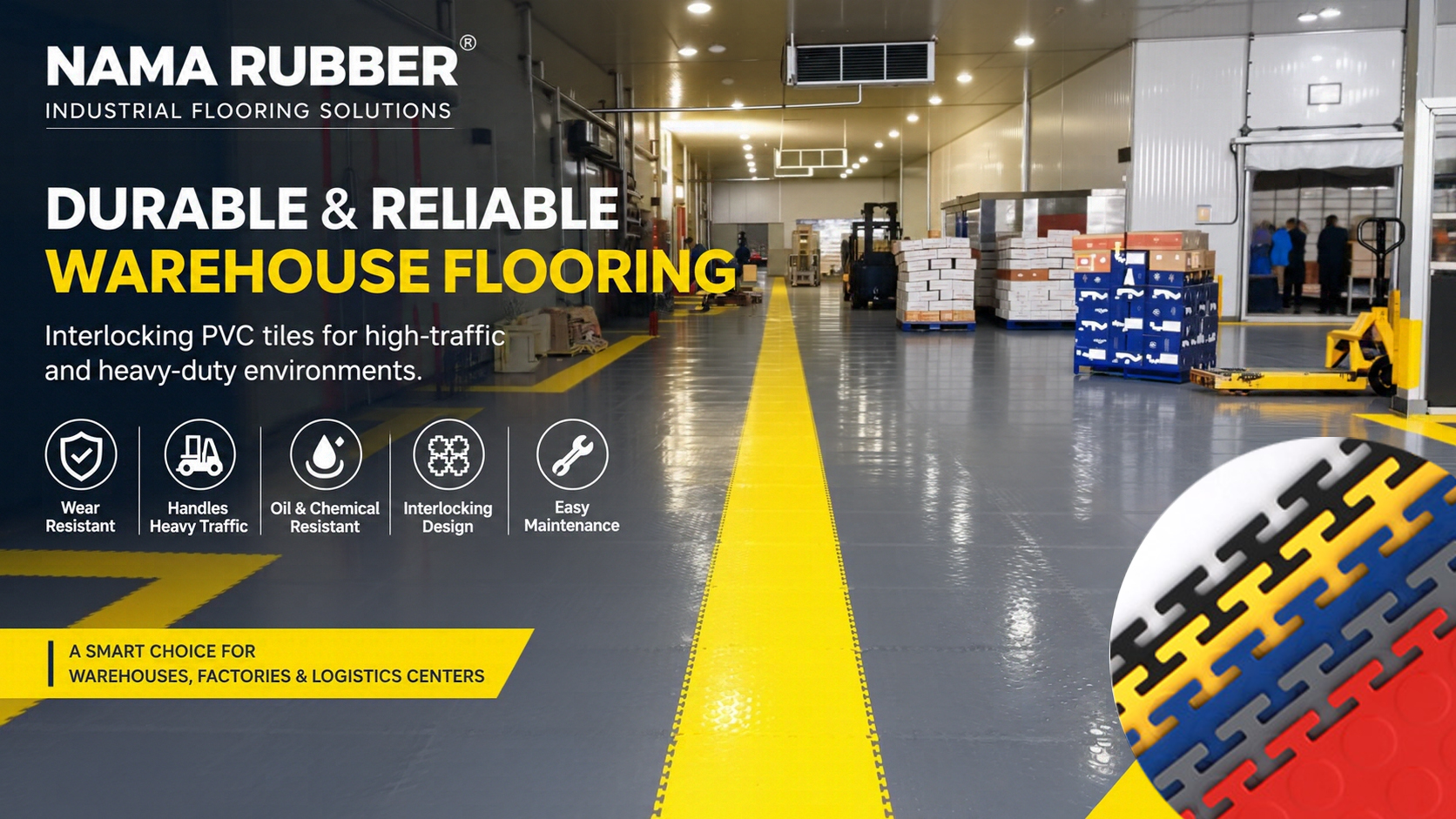
Interlocking PVC tiles provide a modular flooring option for selected industrial environments.
The tiles connect through mechanical locking edges to create a continuous tiled surface.
Depending on the product specification and installation conditions, potential advantages include:
Modular Installation
Tiles can be installed individually, allowing the flooring layout to be adapted to different facility areas.
Localized Replacement
If an individual tile becomes damaged, the affected section may be replaced rather than removing the entire floor.
Actual replacement procedures depend on the installation layout and accessibility.
Flexible Layout Design
Different tile colors can be combined to define:
Storage areas.
Production zones.
Pedestrian walkways.
Equipment parking areas.
Maintenance stations.
Multiple Surface Options
Coin and diamond patterns provide different industrial surface designs.
Buyers can select the pattern based on application requirements and cleaning procedures.
Flexible Renovation Options
Interlocking PVC tiles may be considered when upgrading suitable existing concrete floors.
Before installation, the concrete substrate should be checked for cracks, unevenness, moisture, and contamination.
Important: Interlocking PVC tiles are not automatically suitable for every heavy-forklift application. Mechanical performance must be evaluated under the actual operating conditions.
6. Wear Resistance vs. Load-Bearing Capacity: What Is the Difference?
One common mistake when selecting industrial flooring is treating wear resistance and load-bearing capacity as the same performance characteristic.
They are different properties.
Wear resistance describes how well the flooring surface withstands abrasion and material loss under defined testing conditions.
Load-bearing performance relates to the flooring system's ability to withstand applied loads without unacceptable deformation, damage, or failure.
For example:
A warehouse floor may have good abrasion resistance but still experience joint damage under repeated forklift turning.
Similarly, a tile may support a certain static load but perform differently under repeated rolling loads.
Industrial buyers should evaluate both properties separately.
Static Load vs. Dynamic Rolling Load
Static loads occur when equipment or materials remain stationary on the floor.
Dynamic rolling loads occur when wheels move across the surface.
Dynamic conditions can introduce additional stresses through:
Wheel rotation.
Repeated loading.
Turning.
Braking.
Uneven wheel contact.
Localized pressure.
For forklift applications, the following information is particularly important:
Forklift operating weight.
Maximum loaded weight.
Wheel configuration.
Wheel material and dimensions.
Load distribution.
Traffic frequency.
Turning and braking locations.
The complete flooring system should be evaluated against these operating conditions.
7. How to Choose the Right PVC Flooring Thickness for Heavy Traffic
Industrial PVC tiles are available in different thicknesses to meet different application requirements.
The correct thickness depends on the intended use rather than a simple rule that thicker is always better.
Consider the following general selection approach:
Application
Key Selection Considerations
Light-duty workshops
Pedestrian traffic, equipment movement, substrate condition
General industrial areas
Repeated traffic, surface wear, tile stability
Warehouse operations
Pallet truck traffic, wheel loads, joint strength
Forklift operating areas
Wheel loads, turning, braking, dynamic rolling performance
Heavy industrial environments
Actual equipment loads, impact, mechanical testing
For industrial PVC tiles, 7 mm, 8 mm, and 10 mm options may be considered depending on the product design and application.
However, thickness alone should never be used as proof of forklift suitability.
Request relevant test information and evaluate the complete installation system before specifying a product for heavy equipment traffic.
8. How to Maintain Industrial PVC Flooring in High-Traffic Areas
Proper maintenance helps preserve the condition of industrial flooring.
Regular Cleaning
Remove dust, sand, and debris regularly.
Small abrasive particles can contribute to surface wear when repeatedly compressed or dragged across the floor.
Clean Oil and Chemical Spills
Clean spills promptly using cleaning products approved for the specific PVC formulation.
Avoid unapproved solvents or aggressive chemicals.
Inspect High-Traffic Areas
Pay special attention to:
Forklift turning points.
Loading and unloading areas.
Machinery entrances.
Pallet storage zones.
Frequently used walkways.
Check for surface wear, damaged tiles, and separated joints.
Check Tile Connections
Inspect interlocking joints periodically, especially in areas exposed to repeated vehicle movements.
Damaged connections should be investigated and repaired according to the manufacturer's recommendations.
Protect the Concrete Subfloor
Keep the substrate clean, dry, and structurally suitable.
Oil contamination, moisture, and uneven concrete can affect flooring stability and service performance.
9. Interlocking PVC Tiles vs. Traditional Industrial Flooring
Different flooring systems have different advantages for heavy-traffic applications.
Flooring Type
Main Characteristics
Considerations
Interlocking PVC Tiles
Modular design and localized replacement
Joint performance and wheel loads
Epoxy Flooring
Continuous resin-based surface
Substrate preparation and installation conditions
Polyurethane Flooring
Available in specialized industrial formulations
Product-specific mechanical and chemical performance
Concrete Flooring
Common structural industrial substrate
Surface abrasion, cracking, and maintenance
Rubber Flooring
Resilient material with different surface options
Formulation, oil compatibility, and rolling-load requirements
There is no universal solution for all industrial facilities.
The right choice depends on traffic intensity, equipment requirements, existing floor conditions, installation preferences, and maintenance plans.
10. What Should Buyers Check Before Purchasing Wear-Resistant PVC Tiles?
Before ordering industrial PVC flooring, procurement teams should review the following information.
Product Specifications
PVC formulation.
Tile dimensions.
Tile thickness.
Weight per tile.
Surface pattern.
Available colors.
Interlocking design.
Technical Performance
Abrasion resistance.
Dimensional stability.
Indentation performance.
Slip resistance.
Locking strength.
Static load performance.
Dynamic rolling-load performance, where applicable.
Installation Requirements
Concrete substrate condition.
Installation method.
Perimeter finishing.
Expansion requirements.
Joint inspection.
Cleaning and maintenance instructions.
Project Requirements
Total installation area.
Traffic intensity.
Forklift specifications.
Pallet truck usage.
Chemical and oil exposure.
Destination country.
Required delivery schedule.
A reliable supplier should be able to explain the product's documented performance and its application limitations.
11. NAMA RUBBER Industrial Interlocking PVC Flooring
NAMA RUBBER supplies industrial interlocking PVC flooring options for warehouses, factories, workshops, and commercial facilities.
Our product range can be evaluated according to different project requirements, including:
7 mm, 8 mm, and 10 mm thickness options, depending on the model.
Industrial coin and diamond surface patterns.
Different color combinations.
Modular interlocking connections.
Project-based OEM and customization requirements.
For high-traffic applications, we recommend evaluating the actual equipment loads, wheel movements, joint stability, and concrete substrate conditions before selecting a flooring specification.
For forklift and pallet truck applications, surface abrasion performance and mechanical load performance should be considered separately.
Explore our Industrial Interlocking PVC Floor Tiles for more product information.
Request a Quotation for Your Industrial Flooring Project
To help us recommend suitable flooring options, please provide:
Project application.
Total floor area (m²).
Required tile thickness.
Preferred surface pattern and color.
Forklift or pallet truck specifications.
Expected daily traffic.
Existing concrete floor condition.
Destination country.
Our team can review your project requirements and discuss suitable industrial PVC flooring options.
Conclusion: Select Industrial Flooring Based on Real Traffic Conditions
Wear-resistant PVC flooring is an option worth evaluating for warehouses, factories, workshops, and other high-traffic industrial environments.
However, selecting the right product requires more than comparing tile thickness or surface patterns.
Material formulation, abrasion resistance, joint strength, rolling loads, and installation conditions all influence the performance of an industrial flooring system.
For facilities with forklifts and heavy material-handling equipment, buyers should pay particular attention to dynamic rolling loads and repeated turning movements.
Looking for wear-resistant industrial PVC floor tiles? Contact NAMA RUBBER to discuss your application and project requirements.
Frequently Asked Questions
1. What is wear-resistant PVC flooring?
Wear-resistant PVC flooring is designed to withstand surface abrasion under defined operating conditions. Its performance depends on material formulation, surface characteristics, manufacturing quality, and testing conditions.
2. Are PVC floor tiles suitable for heavy forklift traffic?
Some industrial PVC tile systems may be suitable for specified forklift applications. However, suitability depends on wheel loads, wheel configuration, turning movements, joint strength, tile thickness, and substrate conditions.
3. Does thicker PVC flooring mean better wear resistance?
Not necessarily. Thickness and surface abrasion resistance are different properties. Both should be evaluated according to the intended application.
4. What is the difference between abrasion resistance and load-bearing capacity?
Abrasion resistance measures the ability to withstand surface wear. Load-bearing capacity relates to the ability to withstand applied forces without unacceptable damage or deformation.
5. Are interlocking PVC tiles suitable for warehouses?
They may be suitable for selected warehouse applications, depending on traffic intensity, equipment loads, tile specifications, and installation conditions.
6. Which surface pattern is better for industrial PVC flooring?
Coin and diamond patterns are common industrial surface designs. The choice depends on application requirements, cleaning procedures, and verified surface performance.
7. How do I maintain wear-resistant PVC floor tiles?
Regularly remove dust and debris, clean spills promptly, use approved cleaning agents, and inspect high-traffic areas and interlocking joints.
8. Can damaged interlocking PVC tiles be replaced individually?
In many modular installations, individual tiles can be replaced without removing the entire flooring system. Accessibility and installation layout affect the replacement process.
9. How can I compare the wear resistance of different PVC flooring products?
Request test reports that identify the test standard, specimen details, test conditions, and measured results. Compare products using the same or equivalent test methods.
Post time: Nov-03-2026