
What Is Modular Industrial Flooring?
Traditional industrial flooring is often installed as one continuous surface.
Epoxy is poured and cured.
Concrete is polished or treated.
Resin systems are applied across the entire floor.
Modular industrial flooring takes a different approach.
Instead of creating one continuous surface, the floor is constructed from individual modules or tiles that connect together to form a larger flooring system.
One of the most common examples is interlocking PVC industrial floor tiles.
These tiles are designed to connect mechanically, allowing large warehouse, factory, workshop, and logistics areas to be covered without necessarily using permanent adhesive.
This modular approach offers an important advantage:
If one section of the floor is damaged, you can often repair that section instead of replacing the entire floor.
For facilities where downtime, maintenance, and future flexibility matter, modular industrial flooring can be a practical alternative to traditional flooring systems.
What Does "Modular Flooring" Mean?
The word modular means that the floor is made from individual components rather than one continuous layer.
A modular industrial flooring system typically consists of:
Individual floor tiles
Interlocking connections
Edge tiles or ramps where required
Corner or transition accessories
Optional colored tiles for zoning
The individual modules are assembled on-site to create one continuous working surface.
Simple Example
Traditional coating:
Concrete → Primer → Coating → Curing → Finished Floor
Modular flooring:
Existing Floor → Inspection/Preparation → Interlocking Tiles → Finished Floor
The exact installation requirements depend on the flooring product and substrate condition.
What Is Interlocking PVC Flooring?
Interlocking PVC flooring is a type of modular industrial flooring made from PVC tiles with mechanical connection systems around their edges.
The tiles are connected together like a puzzle.
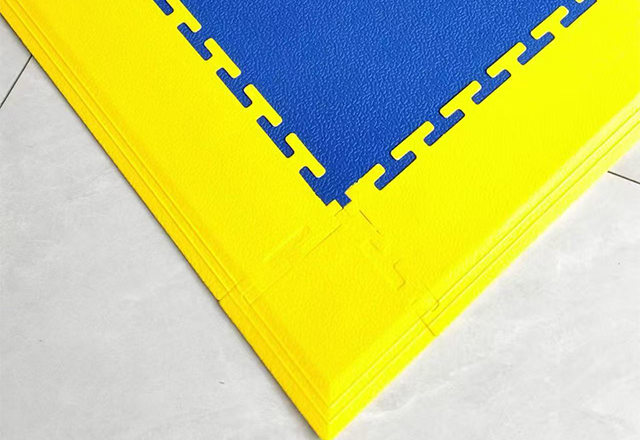
Common tile sizes include:
500 × 500 mm
400 × 400 mm
Other customized formats depending on the manufacturer
Industrial versions are available in different thicknesses and structures to meet different traffic requirements.
For heavy-duty applications, product selection should be based on the actual forklift wheel load, traffic frequency, pallet truck usage, and substrate condition.
How Does Modular Industrial Flooring Work?
The basic principle is simple.
Step 1 — Inspect the Existing Floor
Check:
Cracks
Potholes
Uneven areas
Contamination
Moisture
Damaged joints
Step 2 — Prepare Major Defects
Repair serious surface defects according to the manufacturer's installation requirements.
Step 3 — Plan the Layout
Determine:
Starting point
Main traffic lanes
Columns
Doors
Drains
Machinery
Edges and transitions
Step 4 — Install the Tiles
Connect the tiles mechanically.
Step 5 — Cut Around Obstacles
Tiles can be cut around:
Columns
Walls
Equipment
Door frames
Step 6 — Install Edges or Ramps
Where required, install suitable edge profiles or ramps.
Step 7 — Inspect the Finished Floor
Check the interlocking connections, edges, transitions, and traffic areas before putting the floor into service.
Why Are Modular Industrial Floors Becoming Popular?
Industrial facilities increasingly need flooring systems that are:
Fast + Durable + Maintainable + Flexible
Traditional flooring systems can work extremely well, but they may require significant preparation and installation time.
Modular flooring provides another option.
Its main advantages include:
Fast installation
Easy localized repair
Minimal curing requirements
Low operational disruption
Flexible design
Easy maintenance
Phased installation
1. Fast Installation
One of the biggest advantages of modular flooring is installation speed.
There is no need to wait for multiple wet coating layers to cure when using a suitable adhesive-free interlocking system.
This can be particularly useful for:
Active warehouses
Distribution centers
Manufacturing plants
Rental warehouses
Workshops
For businesses that operate continuously, reducing installation time can have significant economic value.
2. Easy Localized Repair
This is one of the strongest arguments for modular flooring.
Imagine a forklift damages an area near a loading dock.
With a traditional coating system, repair may involve:
Cutting out damaged coating
Grinding
Recoating
Waiting for curing
Matching the existing finish
With modular PVC tiles, the repair process can potentially be much simpler:
Remove damaged tiles → Install replacement tiles → Reconnect → Return to service
The exact repair process depends on the flooring system.
3. Reduced Downtime
For industrial facilities, downtime can be more expensive than flooring material.
Consider a warehouse that operates six or seven days per week.
Closing the entire facility for several days may result in:
Lost production
Delayed shipments
Labor disruption
Inventory movement
Customer delivery issues
A modular floor can often be installed in sections, allowing other parts of the facility to continue operating.
4. No Long Curing Period for Many Systems
Many modular PVC tile systems are installed mechanically rather than through a wet coating process.
This eliminates the long curing stage associated with many resin-based flooring systems.
However, always follow the manufacturer's installation and commissioning instructions.
5. Flexible Installation
Modular flooring can be installed:
Across an entire warehouse
In selected production zones
In forklift aisles
Around machinery
In packing areas
In loading areas
This makes it suitable for phased renovation projects.
6. Easy Maintenance
Industrial environments inevitably experience wear.
A modular system makes maintenance more targeted.
Instead of asking:
"How do we repair 5,000 m²?"
you may only need to ask:
"Which tiles need to be replaced?"
This can simplify maintenance planning.
7. Design & Safety Zoning
Modular flooring isn't limited to one color.
Different colors can help visually separate:
Post time: Aug-24-2026